


For those who read beyond centuries.
Verba Vetera
Introduction
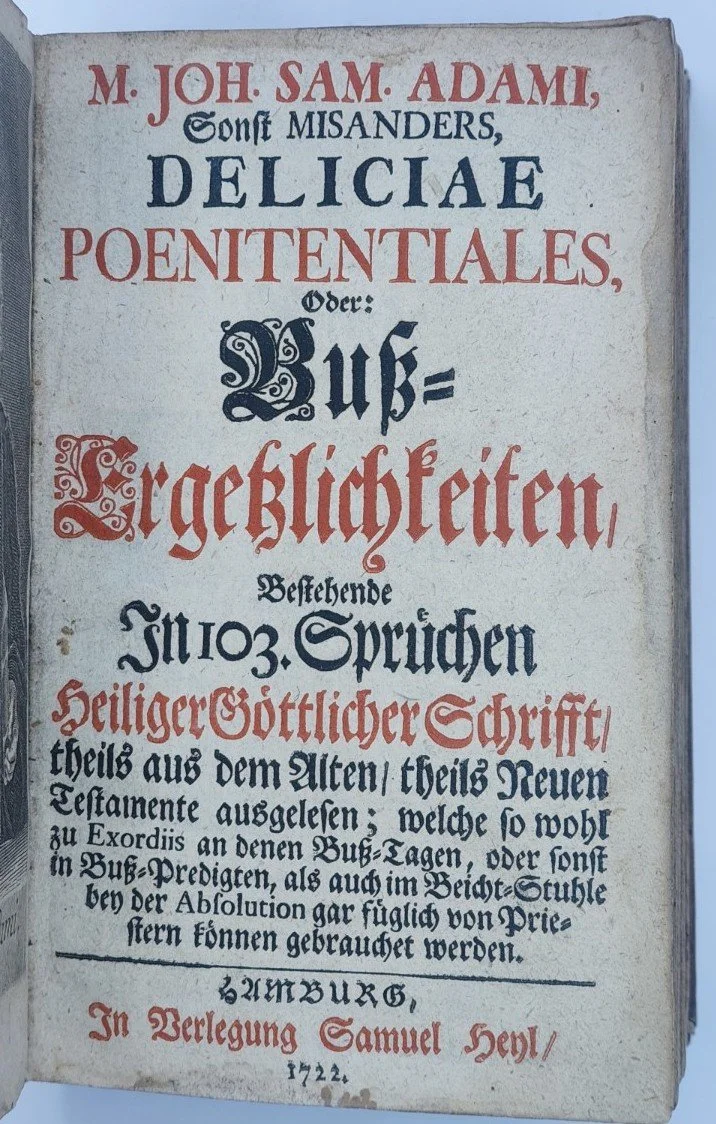
Johann Samuel Adami, better known by his pseudonym Misander, was a prolific Lutheran writer of devotional and theological works. His Deliciae Poenitentiales, Oder: Buß-Ergetzlichkeiten, printed in Hamburg in 1722, is a compact book of penitential devotion: a collection of 103 biblical passages intended for repentance, confession, absolution, and preparation for a Christian death.
This copy is especially evocative because it preserves not only the printed devotional text, but also a contemporary handwritten penitential prayer on the endpaper. The prayer begins “Gott sey mir Sünder gnädig” — “God, be gracious to me, a sinner” — and is also condensed into a symmetrical square of initials above the text. This small manuscript addition gives the volume a strong sense of private devotional use.
Physical description
Author: Johann Samuel Adami, alias Misander
Title: Deliciae Poenitentiales, Oder: Buß-Ergetzlichkeiten
Place of publication: Hamburg
Publisher: Samuel Heyl
Date: 1722
Format: 12mo
Pagination: 735 pages
Language: German
Script/type: German blackletter
Binding: Contemporary or near-contemporary vellum binding
Spine: Manuscript title to spine, partly faded and rubbed
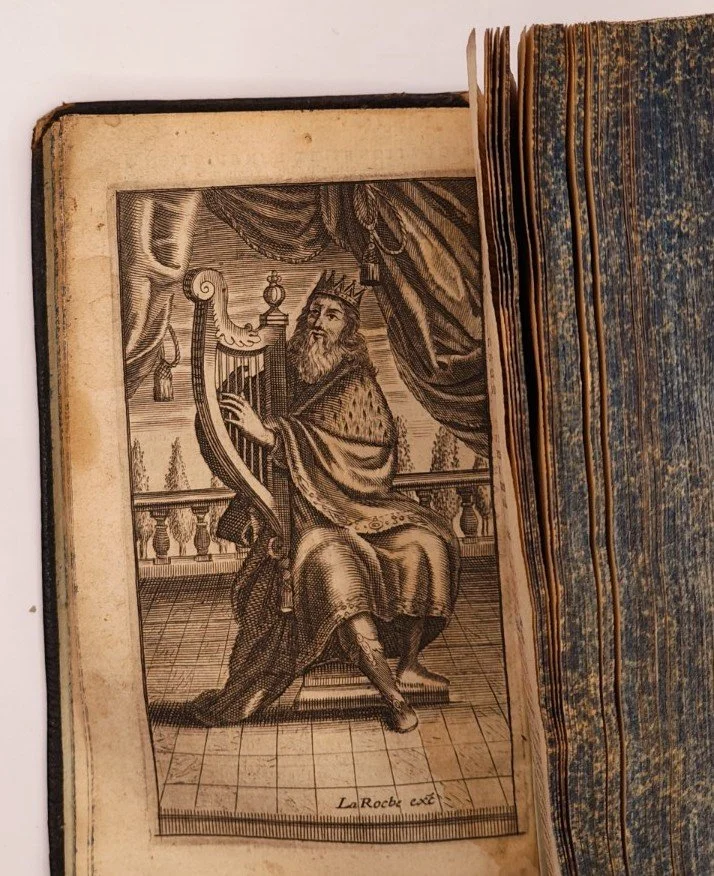
Illustration: Engraved portrait frontispiece of Johann Samuel Adami
Title page: Printed in red and black
Completeness: Complete copy
Manuscript addition: Contemporary devotional note on the endpaper, including a short German penitential prayer and a corresponding square of initials
Condition: Binding soiled, rubbed, stained, and worn, with age-related marks. Interior toned and spotted in places, with signs of use consistent with age. A good antiquarian copy with notable devotional character.
Context
Deliciae Poenitentiales belongs to the world of early eighteenth-century Lutheran devotional literature. Its purpose was practical and pastoral: it gathered biblical passages for use in penitential reflection, on days of repentance, in sermons, and in the context of confession and absolution.
The title itself may be translated loosely as “penitential delights” or “comforts of repentance.” This reflects a central theme of Lutheran devotional writing: repentance was not merely an expression of guilt, but a path toward divine mercy, consolation, and salvation.
The handwritten note in this copy fits the book’s purpose with unusual precision. The prayer reads:
Gott sey mir Sünder gnädig!
So stirbt ein Sünder selig.
Mein Einiger Mittler Erlöse Mich.
So stirbt ein Sünder selig.
Gott sey mir Sünder gnädig.
In English:
God, be gracious to me, a sinner.
Thus a sinner dies blessed.
My only mediator, redeem me.
Thus a sinner dies blessed.
God, be gracious to me, a sinner.
The phrase “Gott sey mir Sünder gnädig” echoes the biblical prayer of the publican in Luke 18:13, while “Mittler” refers to Christ as mediator. The manuscript note is therefore not a random ownership mark, but a deeply appropriate devotional response to the printed book.
Significance
This is a modest but highly atmospheric survival from early eighteenth-century Lutheran devotional culture. Its significance lies not only in the printed text, but in the way this particular copy was used.
The contemporary manuscript prayer transforms the volume from a standard devotional book into an object of personal religious practice. The symmetrical initial square above the prayer suggests memorisation, meditation, or private devotional repetition. It gives the book a direct connection to the inner life of an early reader: repentance, fear of death, hope for mercy, and trust in Christ as mediator.
Preserved in its early vellum binding, complete with engraved portrait and red-and-black title page, this copy offers a compelling example of how religious books were read, handled, and personalised in the Lutheran world of the early eighteenth century.
Introduction
This small seventeenth-century Roman Breviary was printed in Paris in 1660. It is the Pars Aestivalis, the summer part of the Breviarium Romanum, the liturgical book used for the daily offices of the Roman Catholic Church.
Printed in red and black, with engraved illustrations, blue-stained edges, and an early gilt-tooled leather binding, the volume is a compact witness to the post-Tridentine Catholic book world. It was not made as a decorative luxury book, but as a practical object for repeated liturgical use — a book to be handled, read, and carried through the rhythm of daily prayer.
Physical description
Title: Breviarium Romanum. Pars Aestivalis
Place of printing: Paris
Publisher/printer: Apud Societatem Typographicam Librorum Officii Ecclesiastici
Year: 1660
Language: Latin
Printed in red and black
Dense double-column text
Engraved illustrations
Blue-stained edges
Early or contemporary dark leather binding with gilt decoration
Manuscript ownership and use inscriptions to the endleaves
One inscription appears to include the phrase “pro choro”, suggesting possible use in a choir, conventual, or ecclesiastical context
Binding rubbed and worn, with wear to corners, spine, joints, and extremities
Internal age-toning, staining, spotting, and handling wear throughout
Context
The Breviarium Romanum was the central book of the Roman Catholic Divine Office, containing the psalms, hymns, readings, responsories, antiphons, and prayers used throughout the canonical hours. Following the Council of Trent, the Roman Breviary was revised and standardized, becoming one of the defining liturgical books of the post-Tridentine Catholic Church.
This volume belongs to that tradition. As the Pars Aestivalis, it contains the summer portion of the breviary cycle rather than the complete year. Such books were often issued in seasonal parts, allowing the user to carry only the relevant volume for a given period of the liturgical year.
The Paris imprint, red-and-black printing, engraved imagery, and compact format place the book within a world of practical ecclesiastical printing: carefully produced, visually ordered, and intended for sustained religious use.
Significance
What makes this copy especially appealing is the combination of formal liturgical printing and visible traces of use. The early manuscript notes to the endleaves, including the possible “pro choro” inscription, suggest that the book may once have belonged to a choir, convent, or ecclesiastical institution. Such evidence gives the volume a more immediate material history.
Rather than being merely an abstract liturgical text, this is a book with signs of ownership, handling, and devotional practice. Its worn binding, stained leaves, blue edges, engraved illustrations, and manuscript inscriptions all contribute to its character as a surviving working object from seventeenth-century Catholic life.
For collectors of theology, liturgy, early printed books, Catholic devotional material, or books with provenance and use marks, this is a compact but evocative example of the Roman Breviary tradition.
Introduction
This substantial seventeenth-century volume brings together the first two principal parts of Philipp Heinrich Friedlieb’s Florilegium Theologicum, printed in Stralsund, Rostock and Greifswald between 1638 and 1640. Friedlieb’s work belongs to the learned world of Lutheran scholastic theology, where doctrine, biblical interpretation, controversy and preaching were brought together in a systematic form.
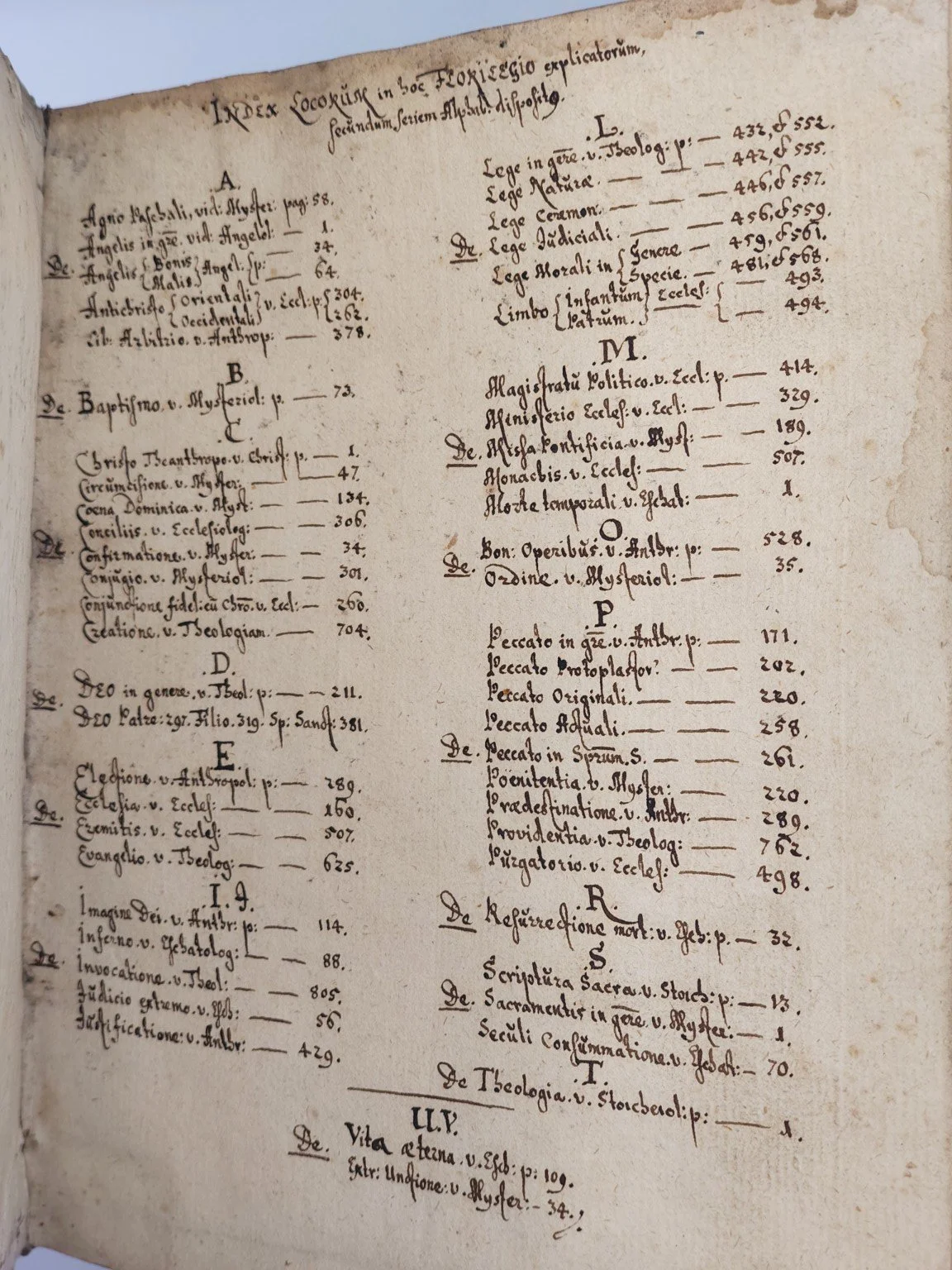
The present copy is especially compelling because it is not merely a preserved theological text. It is a working copy. Throughout the volume are early marginal notes, underlinings, biblical references and polemical observations. At the end is a substantial manuscript index, carefully written by an early owner to make the book searchable and useful as a practical theological instrument.
Physical description
Author: Philipp Heinrich Friedlieb, also Philippus Henricus Friedlieb
Title: Florilegium Theologicum, parts I–II
Contents:
I. Stoicheiologia & Theologia
II. Angelologia & Anthropologia
Place of printing: Stralsund, Rostock and Greifswald
Date: 1638–1640
Language: Latin, with Greek and Hebrew elements
Binding: Contemporary or near-contemporary vellum
Part I: Complete in itself, pp. 1–930, followed by appendix and printed index
Part II: Complete in itself, pp. 1–596, followed by appendix and printed index
Completeness: Complete in the two included parts, but not complete as the full multi-part Florilegium Theologicum
Annotation: Extensive contemporary or near-contemporary marginalia, underlinings, biblical references and scholarly notes
Manuscript material: Substantial handwritten index added by an early owner
Condition: Vellum binding worn, rubbed, soiled and stained, with visible signs of age and use. Interior with age-toning, occasional spotting, wear and extensive early annotation throughout
Context
Philipp Heinrich Friedlieb was a Lutheran theologian of the seventeenth century, working within the intellectual tradition often described as Protestant orthodoxy. His Florilegium Theologicum was conceived as a systematic theological compendium arranged around doctrinal loci, or principal theological subjects.
The first part, Stoicheiologia & Theologia, treats Scripture, God and the foundations of doctrine. The second part, Angelologia & Anthropologia, concerns angels, demons and the nature of man. Friedlieb’s method is characteristic of the period: doctrinal theses are supported by scriptural confirmation, defended against objections and directed toward practical use in preaching.
This was a world in which theology was not only devotional, but also scholarly, polemical and pedagogical. The presence of Latin, Greek and Hebrew reflects the learned Protestant culture of the seventeenth century, where biblical languages and close textual argument played a central role.
Significance
The particular interest of this copy lies in its evidence of use. The marginalia and manuscript index show that an early reader did not simply own the book, but worked with it closely. The volume was read, marked, organized and returned to as a tool for study, disputation and preaching.
The handwritten index is especially important. It transforms the printed book into a personalized reference work, allowing the reader to navigate theological topics, biblical passages and doctrinal arguments more efficiently. In this sense, the volume preserves not only Friedlieb’s text, but also a record of historical reading practice.
As an object, it offers several layers of interest: seventeenth-century Lutheran theology, early modern scholarly method, the history of preaching, book use, marginalia and manuscript indexing. Its worn vellum binding and heavily annotated pages give the book a strong physical presence, making it a vivid survival from the working library of an early modern theological reader.
Introduction
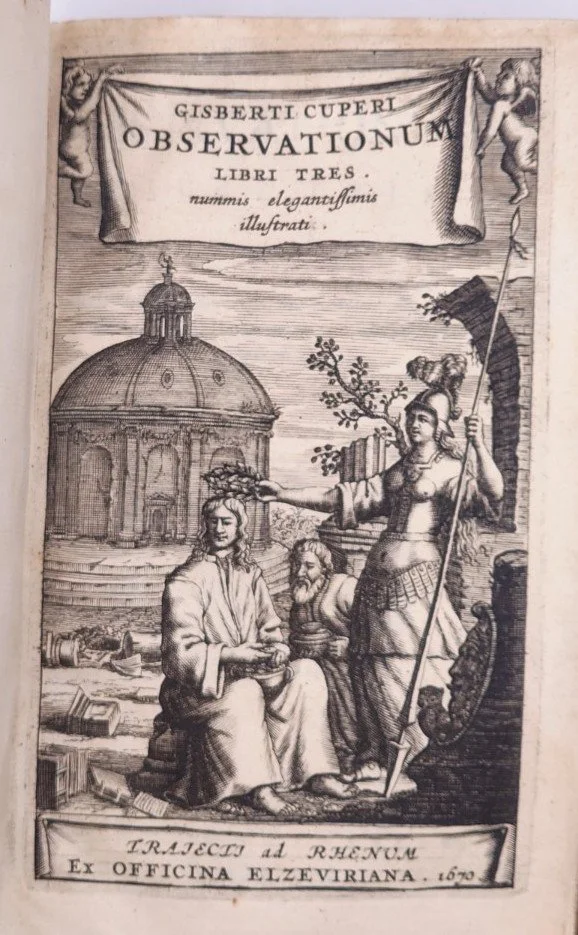
Printed in Utrecht by Petrus Elzevier in 1670, Gisbert Cuper’s Observationum libri tres is a compact and learned work of seventeenth-century antiquarian scholarship. Written in Latin, with frequent Greek passages, it brings together classical philology, ancient rites, textual criticism, and numismatic evidence. The book is especially appealing for its engraved title and numerous copper engraved illustrations in the text, many of them depicting ancient coins, medals, and antiquarian subjects.
Physical description
• Title: Gisberti Cuperi Observationum libri tres
• Author: Gisbert Cuper
• Place of printing: Utrecht, “Trajecti ad Rhenum”
• Printer: Petrus Elzevier
• Year: 1670
• Format: 12mo
• Pagination: [32], 355, [5] pp.
• Language: Latin, with Greek passages
• Binding: Contemporary vellum with yapp edges
• Illustration: Engraved title/frontispiece and numerous copper engraved illustrations in the text
• Complete, with preliminary leaves, main text, index, and illustrations present
• No marginal annotations
• Condition: Vellum somewhat soiled and lightly stained, with minor wear and slight bowing. Edges age toned and spotted. Interior generally well preserved, with some light browning, spotting, and handling marks.
Context
Gisbert Cuper, or Gijsbert Cuperus, was a Dutch classical scholar, antiquarian, and statesman whose work belongs to the learned culture of the Dutch Golden Age. His Observationum libri tres reflects a scholarly world in which texts, inscriptions, coins, medals, and ancient customs were studied together as evidence for understanding antiquity.
The book is not a conventional history, but a collection of learned observations. Cuper moves between Greek and Latin authors, explaining difficult passages, proposing corrections, and using material remains to illuminate ancient practice. The many engraved coins and medals are not merely decorative. They function as evidence, allowing the printed page to combine textual criticism with visual antiquarian inquiry.
The Elzevier imprint adds another layer of interest. The Elzevier family were among the most celebrated Dutch printers of the seventeenth century, known especially for compact scholarly books in elegant small formats. This copy, preserved in its contemporary vellum binding, remains close to the form in which it would have circulated among early modern readers.
Significance
This volume is a fine example of the intersection between classical scholarship, antiquarianism, and numismatics in the seventeenth century. Its interest lies not only in the Elzevier imprint, but also in the way it presents antiquity as something to be reconstructed through both texts and objects.
For collectors, the book offers several appealing features: an Elzevier printing, a contemporary vellum binding, a complete text, an engraved title, and numerous copper engraved illustrations of ancient coins and related subjects. It is a scholarly object, but also a visually engaging one, representing the early modern attempt to recover the ancient world through philology, images, and material evidence.
Introduction
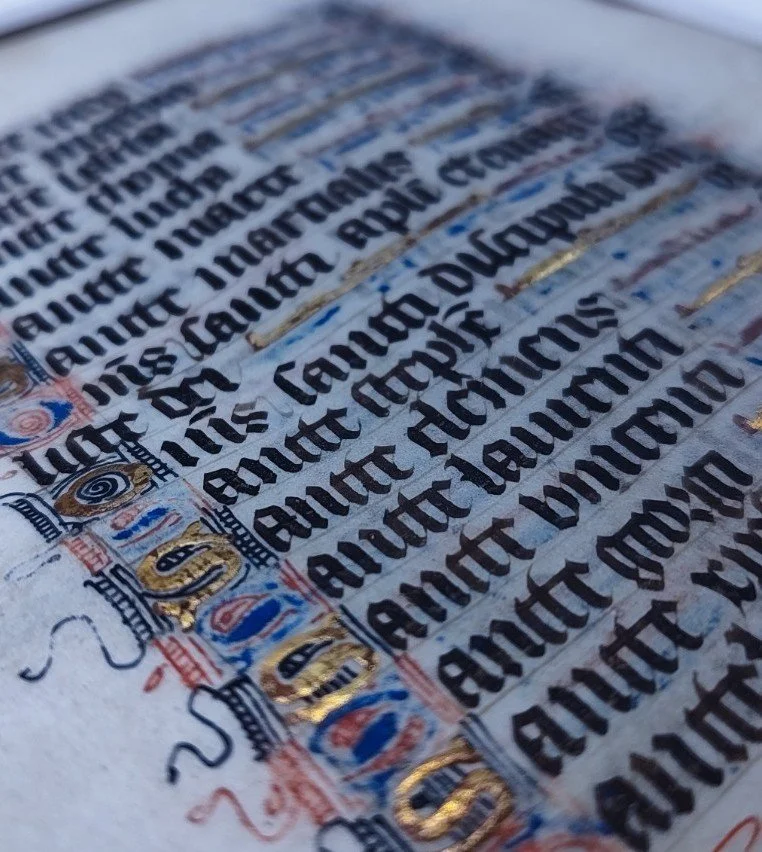
An exceptionally decorative parchment leaf from a late medieval French devotional manuscript, most probably a Book of Hours, containing part of the Litania Sanctorum, or Litany of the Saints. Written on both sides in a formal Gothic hand, the leaf presents a rhythmic sequence of invocations, each asking a saint to intercede for the reader: ora pro nobis, “pray for us.”
The visual richness of the leaf is particularly striking. Rows of gold, blue and red initials form a continuous ornamental border beside the text, while gilt and coloured line fillers extend across the page. The repetition of prayer and decoration transforms the litany into a carefully ordered act of devotion, at once textual, visual and meditative.
Most significantly, the litany includes Saint Martial among the apostles, together with Saint Leonard and Saint Gerald. This combination points strongly toward a manuscript associated with Limoges or the surrounding Limousin region, where Saint Martial was venerated not merely as the city’s first bishop, but according to a distinctive medieval tradition, as an apostolic figure.
Physical description
• Single parchment leaf, written on both recto and verso
• Leaf dimensions: 19 × 14 cm
• Framed dimensions: 24 × 18 cm
• Latin text in a formal Gothic bookhand, written in dark brown to black ink
• Text from the Litania Sanctorum, with repeated invocations ending ora pro nobis
• Numerous initials illuminated in gold, blue and red, arranged as a decorative vertical sequence along the left side of the text block
• Extensive line fillers in gold, blue and red
• Fine marginal penwork in black and red ink
• Saints named include Martial, Leonard, Gerald, Martin, Nicholas, Augustine, Lawrence, Vincent, George, Christopher and others
• Later pencil foliation or collector’s number “96” in the upper right corner
• France, probably Limoges or the Limousin region, 15th century, perhaps second half of the century
• Visible toning, staining, surface wear and waviness to the parchment, consistent with age and earlier exposure to moisture
• Mounted in a window mat and adhesively attached at the upper edge only
• Professional conservation assessment is recommended before any attempt at removal or remounting
Context
The Litany of the Saints was a central devotional text in medieval Christianity. In a Book of Hours it commonly followed the Penitential Psalms, guiding the reader through a solemn sequence of appeals to apostles, martyrs, confessors, virgins and the collective company of heaven. Each short invocation invited the reader to participate in a spiritual community extending far beyond the visible world.
On this leaf, the ordered procession of saints moves from apostles and evangelists into martyrs and confessors. Names such as Stephen, Lawrence, Vincent, Sebastian, Martin, Augustine and Nicholas belong to the wider devotional vocabulary of the medieval Church. Others are more revealing. Saint Martial, Saint Leonard and Saint Gerald evoke the religious landscape of south-central France, especially Limousin and its neighbouring regions.
Saint Martial is particularly important. In medieval Limoges, his cult developed around the belief that he had been sent directly as an apostle to bring Christianity to Gaul. His placement here among the apostles rather than among ordinary bishops or confessors is therefore a meaningful regional marker. The leaf does not merely preserve a generic litany. It retains evidence of the local devotional identity of the manuscript from which it was removed.
Significance
This leaf is compelling both as an illuminated object and as a fragment of a once coherent devotional manuscript. Its extensive use of gold and colour gives unusual visual prominence to a text based on repetition and prayer, allowing each invocation to appear as a separate, carefully ornamented act of appeal.
Its greater significance lies in the particular saints it records. The inclusion and liturgical placement of Saint Martial, together with Leonard and Gerald, provide an unusually informative clue to the original manuscript’s regional character. The leaf can therefore be approached not simply as an attractive medieval fragment, but as surviving evidence of a devotional tradition associated with Limoges or the wider Limousin region.
Despite later staining, waviness and an unsuitable adhesive mounting at the upper edge, the leaf retains remarkable presence. Its luminous gold initials, disciplined Gothic script and locally meaningful litany offer a tangible connection to the private prayers, sacred geography and manuscript craftsmanship of fifteenth-century France.
Introduction
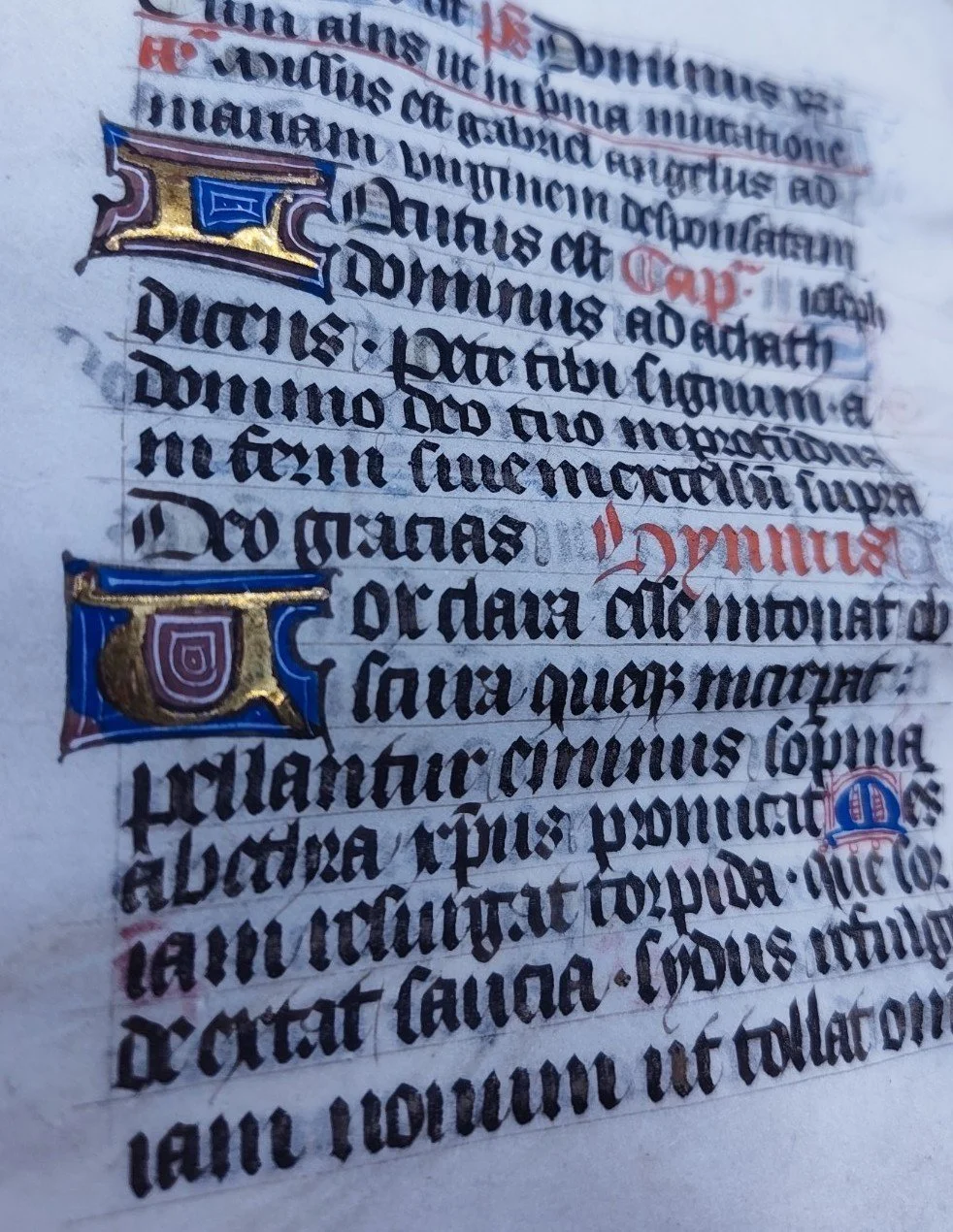
A finely illuminated parchment leaf from a late medieval Latin devotional manuscript, most plausibly a Book of Hours or a small breviary, containing texts associated with the Advent Office. Written on both sides in a dense Gothic script, the leaf is distinguished by burnished gold initials, deep blue and red decoration, and delicate marginal penwork.
The texts evoke one of the central themes of Advent: the expectation of Christ’s coming through the Annunciation to the Virgin. Among the legible passages are the responsory beginning Missus est Gabriel angelus ad Mariam virginem, the hymn Vox clara ecce intonat, and the Marian antiphon Spiritus sanctus in te descendet, Maria. Together they place the leaf within the devotional rhythm of prayer and preparation that preceded Christmas in the medieval liturgical year.
Physical description
• Single parchment leaf, written on both recto and verso
• Leaf dimensions: 19 × 14 cm
• Framed dimensions: 24 × 18 cm
• Latin text written in a formal Gothic bookhand in dark brown to black ink
• Rubrics, liturgical initials and line divisions highlighted in red
• Several illuminated initials executed in gold, blue and red, with decorative pen flourishes extending into the margins
• Decorative line fillers in blue and gold
• Text includes portions of the Advent Office, including Missus est Gabriel angelus, Vox clara ecce intonat and Spiritus sanctus in te descendet, Maria
• Probably produced in northern France or the Southern Netherlands, late 15th century
• Visible toning, staining and waviness to the parchment, particularly on the side with the larger initials
• Presently mounted in a window mat and attached with white adhesive strips at the upper and lower edges
• Conservation note: the adhesive mounting is not appropriate for parchment and should be assessed by a professional conservator before any attempt at removal or remounting
Context
Books of Hours were among the most personal manuscripts of the later Middle Ages. Produced for private devotion, they allowed their owners to follow a daily sequence of prayers modelled on the monastic hours. Their pages were intended to be handled, contemplated and revisited throughout the year, with certain sections adapted to important liturgical seasons.
This leaf belongs to the devotional world of Advent. The text Missus est Gabriel angelus ad Mariam virginem recalls the sending of the Archangel Gabriel to the Virgin Mary, while the hymn Vox clara ecce intonat summons the faithful to prepare for the approaching presence of Christ. The prayerful language of expectation, repentance and divine arrival would have been especially resonant in the weeks before Christmas.
The leaf’s decoration reinforces its devotional purpose. Its gold and coloured initials do not merely embellish the page. They mark transitions within the prayer sequence, guiding the reader through hymns, responses and antiphons while transforming the written word into an object of visual meditation.
Significance
This leaf preserves a fragment of late medieval private devotion at the intersection of text, ritual and craftsmanship. Its carefully ruled parchment, formal Gothic script and illuminated initials reflect the skilled labour required to produce even a single folio of a manuscript intended for prayer.
Particularly appealing is the survival of identifiable Advent texts centred on the Annunciation and the anticipated coming of Christ. Rather than an isolated decorative fragment, the leaf retains a clear liturgical identity and offers a tangible connection to the seasonal practices of its original owner.
The visible marks of age, including staining and later mounting, form part of the object’s history, although the adhesive attachment now requires careful handling. Even in its present condition, the leaf remains an evocative example of the intimate, richly ornamented manuscripts through which medieval readers encountered sacred time and personal prayer.
Introduction
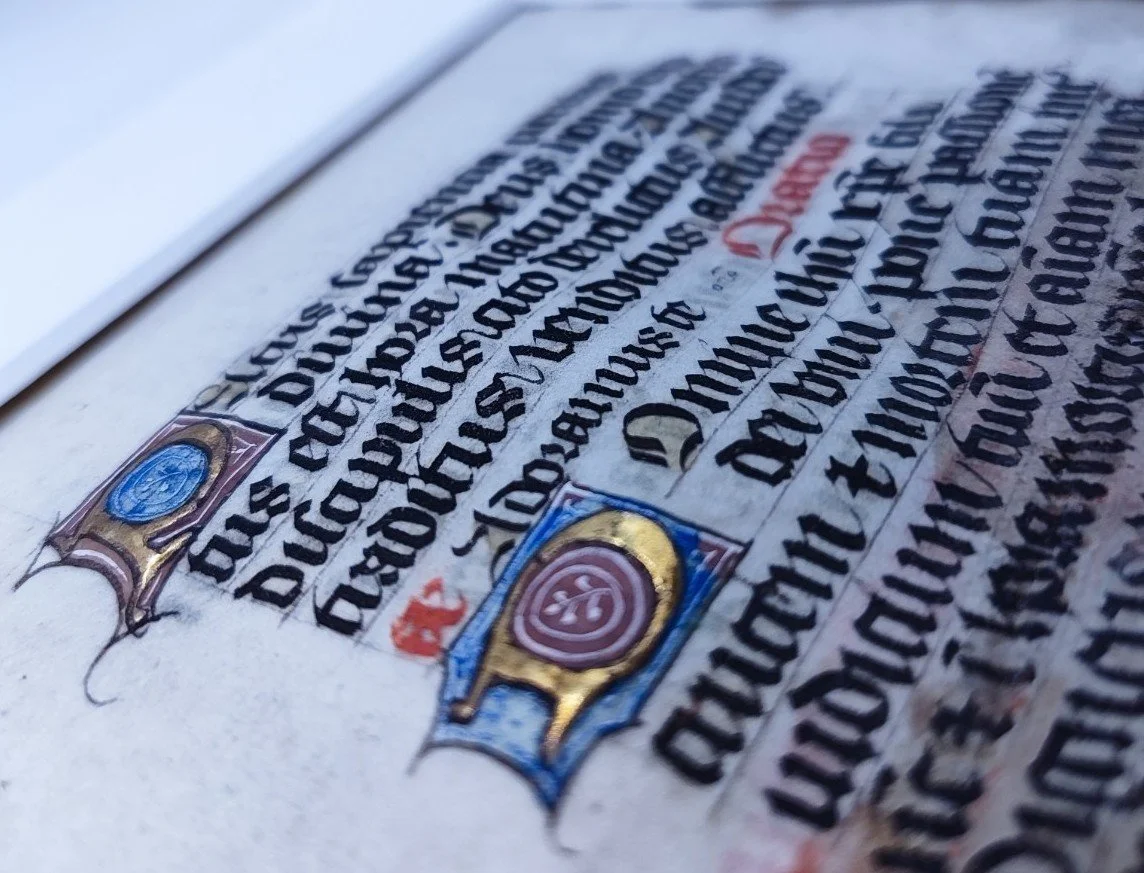
This illuminated manuscript leaf is a late medieval survival from a Latin Book of Hours or private devotional manuscript, written on vellum and decorated with burnished gold initials. Produced most likely in France or the Southern Netherlands in the second half of the fifteenth century, it belongs to the intimate world of private prayer that shaped much of late medieval devotional life.
The text includes part of the Passion hymn Patris sapientia, veritas divina, a meditation on the suffering of Christ arranged around the hours of the day. The reverse contains a prayer to Christ, invoking his Passion, Cross and Death as intercession between the soul and divine judgement. Together, the two sides preserve a deeply personal form of late medieval piety, centred on the Passion as both meditation and spiritual protection.
Physical description
Single manuscript leaf on vellum.
Approximate size of leaf: 18 × 14 cm.
Approximate mounted size: 24 × 18 cm.
Written on both sides in Latin.
Gothic textura script in dark ink.
Rubrication in red.
Several illuminated initials in blue, red, brown and burnished gold.
The largest initial is accompanied by decorative penwork extending into the margin.
Text includes part of Patris sapientia, veritas divina and a prayer beginning Domine Ihesu Christe fili Dei vivi.
Mounted in a later mat, with the upper edge of the vellum leaf adhered to the mount.
Condition includes staining, cockling, edge darkening, rubbing to pigments and gold, and a visible horizontal mounting or repair strip at the left margin.
Text remains legible on both sides, with the illumination still attractive and decorative.
Context
Books of Hours were among the most widely used devotional manuscripts of the late Middle Ages. Unlike large liturgical books made for church choirs or monastic use, Books of Hours were intended for private devotion. They allowed lay readers to structure prayer around the rhythm of the day, combining liturgical texts, psalms, prayers to the Virgin, offices for the dead, suffrages to saints and meditations on the Passion of Christ.
This leaf appears to come from a Passion section within such a book, or from a closely related private prayer manuscript. The hymn Patris sapientia was a popular late medieval meditation on Christ’s Passion. It follows the events of the Passion through the canonical hours, transforming the structure of the day into a sequence of remembrance, contrition and devotion.
The accompanying prayer to Christ asks that his Passion, Cross and Death stand between the soul and divine judgement. This language is characteristic of late medieval devotional practice, in which the suffering of Christ was contemplated not only as a historical event, but as a present source of mercy, protection and salvation.
Significance
This leaf is significant as a tangible remnant of the devotional culture of the fifteenth century. Its text and decoration reflect the intimate relationship between manuscript, prayer and daily religious life. The use of vellum, Gothic script, red rubrication and gold initials places it within the visual language of late medieval piety, where even relatively small books could be richly adorned.
Although it is not a grand miniature leaf, its importance lies in its direct connection to private devotion. The prayers preserved here were meant to be read, recited and contemplated by an individual reader. The leaf therefore offers a close view of how late medieval Christians engaged with the Passion of Christ through text, image, rhythm and material beauty.
The combination of identifiable Passion texts, decorative gold initials and a compact Book of Hours format makes this a meaningful example of manuscript culture at the threshold between the medieval and early modern worlds.
Introduction
Printed in Norrköping in 1729 and associated with the clerical publisher Reinerus Broocman, this volume of Samtlige Söndags och Helgedags Evangelier belongs to a long tradition of Swedish devotional literature structured around the liturgical year. Intended for the reading of Gospel passages on Sundays and feast days, such books occupied a central place in both parish worship and domestic religious life during the early eighteenth century.
This particular copy, however, distinguishes itself not only through its survival, but through the clarity with which its later history can be traced.
Physical description
Norrköping, 1729
4to format
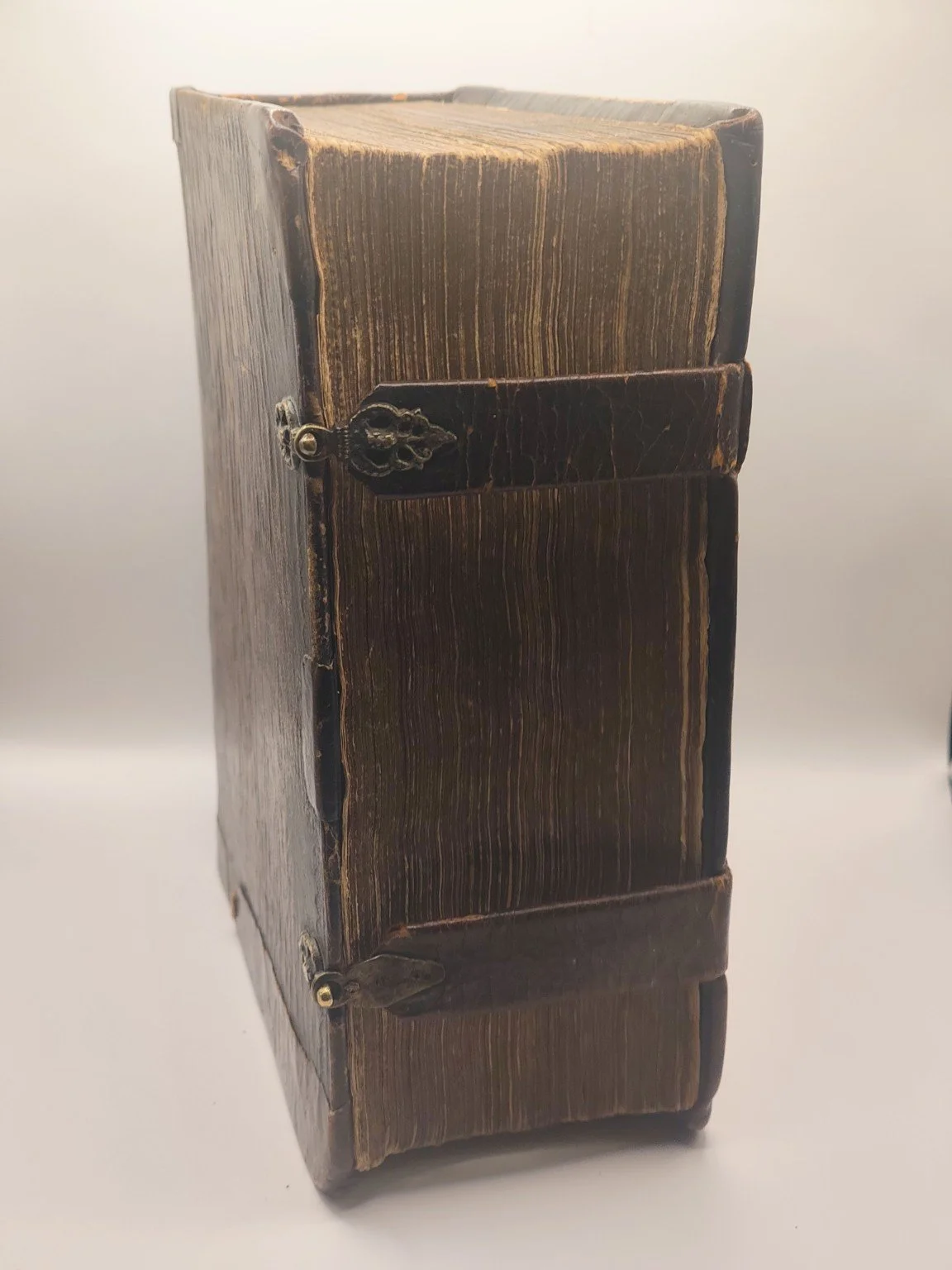
Contemporary full leather binding
Blind-stamped decoration to boards
Original metal clasps preserved (worn but intact)
Text complete and legible throughout
Toning and staining consistent with age and use
Structural wear to binding, but sound
Context
Evangelia of this kind formed part of the textual backbone of Lutheran practice in Sweden following the Reformation. While the Bible itself held doctrinal authority, collections of prescribed readings such as this provided an accessible and structured way for both clergy and laypeople to engage with scripture across the calendar year.
Norrköping, as a provincial printing centre, played a significant role in the dissemination of religious texts during this period. The association with Reinerus Broocman situates the volume within a network of clerical publishing that sought to supply both ecclesiastical and domestic demand.
Significance
The manuscript inscription contained within the volume offers a rare and unusually detailed record of ownership. The book is recorded as belonging to Anders Persson Viklund of Hammarby in Edebo parish, born in 1810, and his wife Brita Gustavia Matsdotter, born in 1813. It later passed to their granddaughter Margreta Erika Sjölund, born in 1865, who resided in Godsta in Häverö parish.
Such continuity transforms the volume from a general devotional text into a documented family object, preserved and transmitted across generations within a specific rural Swedish milieu. The survival of its original binding, complete with clasps, further reinforces its integrity as a historical artifact.
Taken together, these elements position the book not merely as an example of early eighteenth-century printing, but as a material witness to the devotional and familial life of Sweden across the nineteenth century.
Introduction
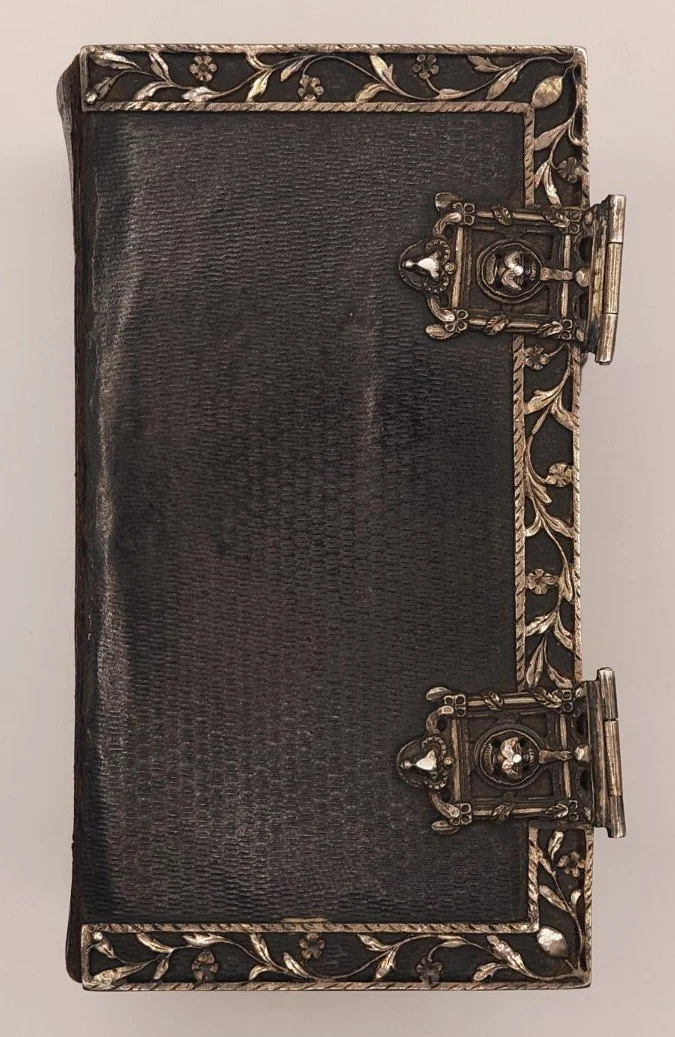
A finely produced Dutch miniature Bible, printed in Dordrecht in 1794, preserved in an elaborate contemporary silver-mounted binding. Compact in scale yet rich in material presence, this volume exemplifies the enduring appeal of the Statenbijbel in its more intimate, personal form. The addition of ornate silver mounts and clasps transforms the book from a purely devotional object into something both tactile and ceremonial, reflecting the cultural importance of scripture within domestic and private life in the late eighteenth century.
Physical description
Dutch Statenbijbel (States Bible)
Printed in Dordrecht, 1794
Miniature format, intended for personal use
Contemporary binding with extensive silver mounts
Two beautifully adorned silver clasps
Pierced and engraved silver decoration with floral motifs
Gilt edges
Illustrated with engraved plates, including scenes from Genesis
Textblock complete and stable
Partial separation at the inner hinge (visible between cover and first leaf)
Light wear and oxidation to silver, consistent with age
Context
The Statenbijbel, first commissioned by the States General in the seventeenth century, remained the authoritative Dutch Bible well into the eighteenth century. By the time of this 1794 printing, such editions were no longer political statements of national identity, but deeply embedded elements of personal religious life. Smaller formats, such as the present example, were designed for portability and private devotion, often accompanying their owners in daily routines or travel.
The addition of silver mounts reflects a longstanding Northern European tradition of elevating devotional books through precious materials. In the Dutch context, these bindings occupy a space between object and heirloom, combining utility with craftsmanship. Produced on the eve of major political change in the Netherlands, this volume also belongs to a moment when older forms of religious and material culture were about to encounter a rapidly shifting world.
Significance
This example stands out not for textual rarity, but for its material and visual qualities. The survival of its silver mounts and clasps, combined with its compact format and engraved illustrations, gives it a strong presence as an object. It is representative of a category of books that were meant to be held, used, and preserved, rather than merely read.
As such, it appeals both to collectors of early printed books and to those drawn to historical bindings and devotional artifacts. It remains a compelling witness to the intersection of faith, craftsmanship, and everyday life in the late eighteenth century.
Introduction
A complete six-volume set of Abbé Jean-Antoine Nollet’s Leçons de physique expérimentale, published in Paris between 1768 and 1771, represents one of the most influential and visually compelling scientific works of the Enlightenment. Conceived not as an abstract treatise but as a series of demonstrative lessons, the work translates natural philosophy into tangible experience. It is a library formed at the moment when science became public, performative, and profoundly visual.
Physical description
• Six volumes, complete
• Published in Paris, 1768–1771 (various contemporary editions)
• Contemporary full calf bindings
• Richly gilt-decorated spines with contrasting title labels
• Uniform appearance across all volumes
• Red-dyed page edges
• All engraved plates present
• No worming, no repairs
• Internally clean and well-preserved
• Moderate wear to bindings consistent with age
Context
Jean-Antoine Nollet was among the foremost scientific communicators of the eighteenth century, closely associated with the spread of experimental physics across Europe. At a time when scientific knowledge was shifting from private academies to broader audiences, Nollet’s lectures and publications played a decisive role in shaping how science was taught, seen, and understood.
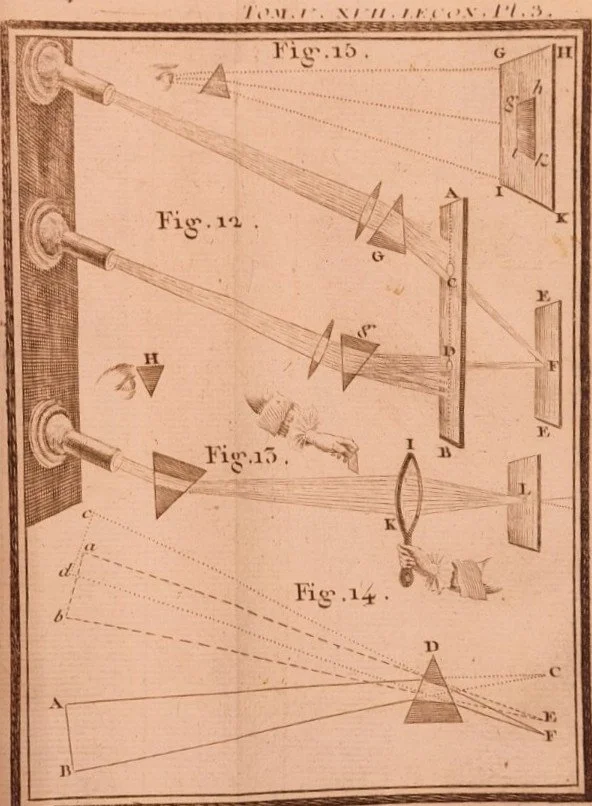
Leçons de physique expérimentale belongs to this transitional moment. Rather than presenting theory alone, the work is structured around experiment and demonstration, reflecting a culture in which scientific phenomena were staged before audiences. Electricity, optics, mechanics, and acoustics are explored through apparatus and observation, often accompanied by finely engraved illustrations that served both pedagogical and aesthetic purposes.
Significance
This set stands at the intersection of science, craftsmanship, and visual culture. Its engraved plates capture not only the instruments of early modern physics but also the intellectual ambition of the Enlightenment: to render the invisible forces of nature visible and comprehensible.
As an object, the work functions simultaneously as a scientific document and as a decorative ensemble. The uniform bindings, the rhythm of the volumes, and the visual richness of the plates together create a presence that extends beyond the purely textual. It is a library in miniature, embodying both knowledge and its material form.
Complete and well-preserved sets of Nollet’s work remain enduringly desirable, appealing to collectors of scientific history as well as to those drawn to the aesthetics of eighteenth-century books.
Introduction
Few subjects captured the imagination of nineteenth century Europe as powerfully as ancient Egypt. Following the decipherment of hieroglyphs and the growing wave of archaeological discoveries along the Nile, Egyptology emerged as one of the most fascinating fields of historical inquiry. Among the books that brought this ancient civilisation to a wider audience, Aegypten in Bild und Wort stands out as one of the most ambitious and visually impressive.
Written by the German Egyptologist Georg Ebers and published in Stuttgart and Leipzig by Eduard Hallberger in 1879, this monumental two volume work sought to present the world of ancient Egypt through both scholarship and imagery. Combining detailed historical narrative with hundreds of illustrations, the book offered nineteenth century readers a richly visual journey through temples, monuments, landscapes, and daily life along the Nile.
Large, dramatic, and beautifully illustrated, the work belongs to the great tradition of Victorian illustrated books that transformed new archaeological discoveries into works of art for the private library.
Physical description
• Two volumes
• Published Stuttgart and Leipzig, Eduard Hallberger, 1879–1880
• Large folio format
• Original decorative publisher’s cloth bindings
• Elaborate blind stamped ornament to boards
• Gilt decorated spines
• Distinctive turquoise decorative inlays to the covers
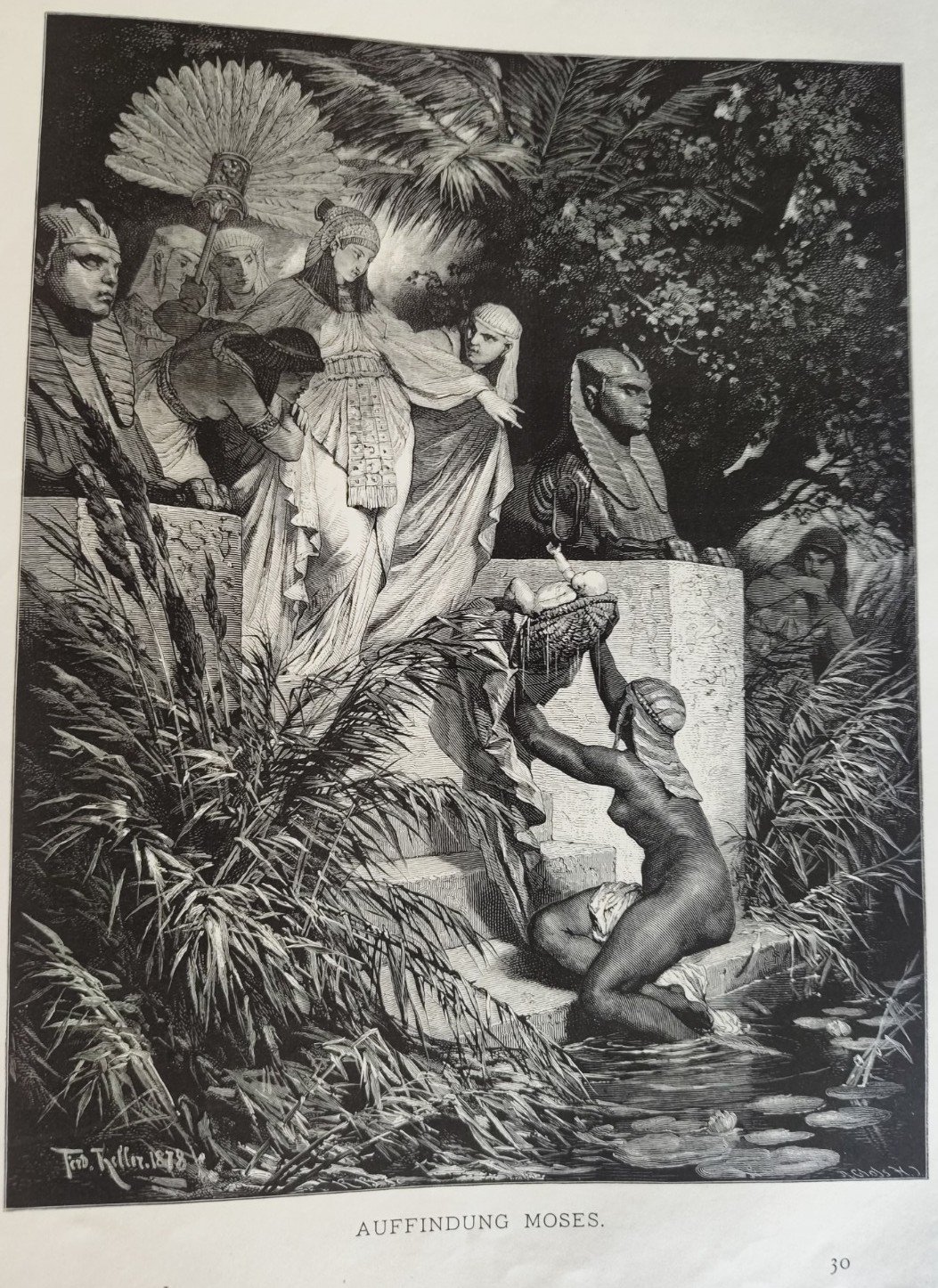
• Profusely illustrated throughout with several hundred wood engraved illustrations and plates
• Includes coloured maps as issued
• Illustrations depicting Egyptian temples, monuments, landscapes of the Nile, reconstructions of ancient life, and biblical scenes set in Pharaonic Egypt
Context
The late nineteenth century witnessed an extraordinary surge of European interest in the ancient world of Egypt. Following the decipherment of hieroglyphic writing by Jean François Champollion earlier in the century, the civilisation of the pharaohs could at last be studied and understood in unprecedented detail. Archaeological expeditions and scholarly publications brought temples, inscriptions, and artefacts to the attention of scholars and the public alike.
Within this atmosphere of discovery, Georg Ebers emerged as one of the most influential figures of early Egyptology. Known both as a scholar and as a popular writer, Ebers sought to present ancient Egypt not merely as an academic subject but as a living civilisation accessible to a broader audience.
Aegypten in Bild und Wort was conceived as a monumental visual introduction to this world. The text provides historical explanation and cultural interpretation, while the illustrations recreate the architecture, landscapes, and ceremonial life of ancient Egypt with remarkable detail. The result is a work that combines scholarship, artistry, and the nineteenth century fascination with the distant past.
Significance
More than a century after its publication, Aegypten in Bild und Wort remains one of the most striking illustrated books devoted to ancient Egypt. Its hundreds of engravings capture the Victorian imagination at a moment when archaeology and historical curiosity were reshaping the European understanding of antiquity.
The elaborate decorative binding with its turquoise ornamentation reflects the book’s original role as a display piece within the cultivated libraries of the nineteenth century. Such works were designed not only to educate but also to inspire wonder, inviting readers to travel imaginatively along the Nile and encounter the monuments of one of the world’s oldest civilisations.
Today the work stands at the intersection of scholarship, book art, and cultural history. It appeals to collectors of Egyptology, admirers of nineteenth century illustrated books, and those drawn to the enduring mystery and beauty of ancient Egypt.
Introduction
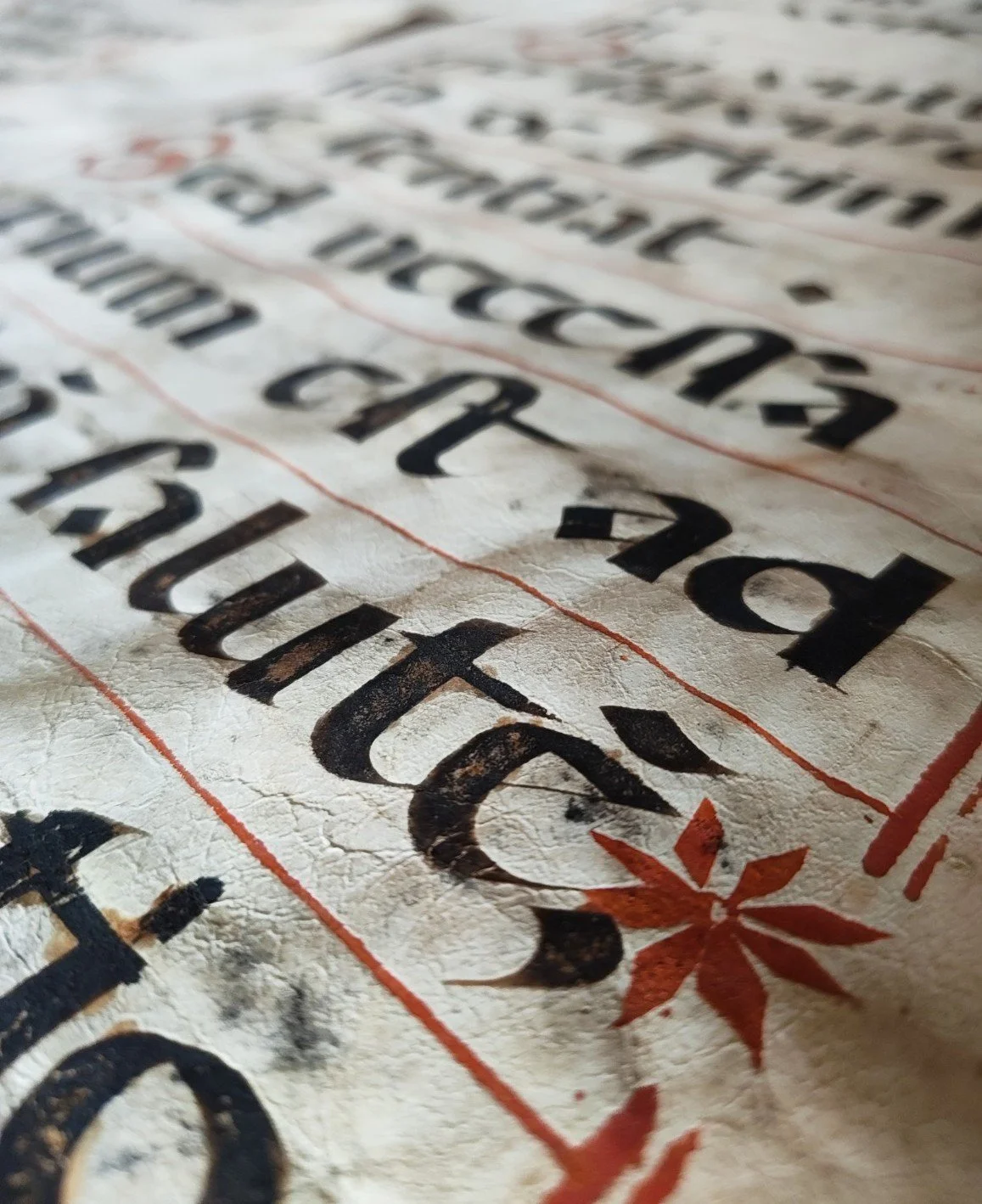
These impressive manuscript leaves originate from a large fifteenth century liturgical choirbook produced in Italy. Written on parchment in a clear Gothic rotunda script with red rubrication and decorative lombard initials, the pages contain passages from the Athanasian Creed, one of the most important doctrinal texts of medieval Western Christianity. The manuscript once formed part of a monumental volume designed for communal reading in a church or monastery, where several singers could follow the text simultaneously from a lectern. Even today, the scale and clarity of the script evoke the visual power of the medieval liturgy.
Physical description
Two parchment manuscript leaves
Italy, probably Northern Italy
Circa 1450 to 1480
Large choirbook format
Dimensions: 52 × 36.5 cm
Written on both sides
Gothic rotunda script in black ink
Red rubrication and lombard initials
Decorative red star markers used to structure the liturgical text
Original foliation numbers 21 and 26 visible
Text from the Athanasian Creed
Context
The Athanasian Creed was one of the three great creeds of the Western Church and played an important role in medieval theology and liturgy. Its opening words, Quicumque vult salvus esse (“Whoever wishes to be saved”), introduce a detailed formulation of Trinitarian doctrine and the nature of Christ as both God and man. During the Middle Ages the creed was recited or sung in the Divine Office, especially on Sundays and certain feast days. Large choirbooks such as the one from which these leaves originate were produced for communal liturgical use, allowing monks or clerics gathered in the choir to read from a single monumental volume.
Significance
These leaves offer a direct material connection to the intellectual and devotional life of the late medieval Church. Their generous scale, clear script, and rubricated structure reflect the practical needs of liturgical performance while also demonstrating the craftsmanship of manuscript production in fifteenth century Italy. Surviving choirbook leaves are valued not only as historical documents but also as striking visual artifacts of medieval culture. They preserve the rhythm of the spoken creed, the artistry of Gothic script, and the enduring presence of a text that shaped theological thought for centuries.
Introduction
Révolutions de Portugal by René Aubert de Vertot is a vivid eighteenth-century historical account of the dramatic events that reshaped the Portuguese monarchy in the seventeenth century. First published in the early eighteenth century and widely reprinted thereafter, Vertot’s work narrates the uprising of 1640 in which Portugal broke away from Spanish rule and restored its independence under the House of Braganza. Written in an engaging narrative style rather than a purely academic tone, the book became one of the most widely read historical treatments of the Portuguese Restoration.
This 1768 Paris edition reflects the enduring popularity of Vertot’s work during the Enlightenment, when readers across Europe developed a growing appetite for accessible political histories. Copies such as this were intended for both education and private reading, offering a dramatic account of revolution, royal succession, and the reshaping of European power.
Physical description
Paris: Chez Brocas, 1768
Format: 12mo (small portable volume)
Contemporary mottled calf binding
Gilt-decorated spine with title label
Engraved frontispiece depicting events of the Portuguese uprising
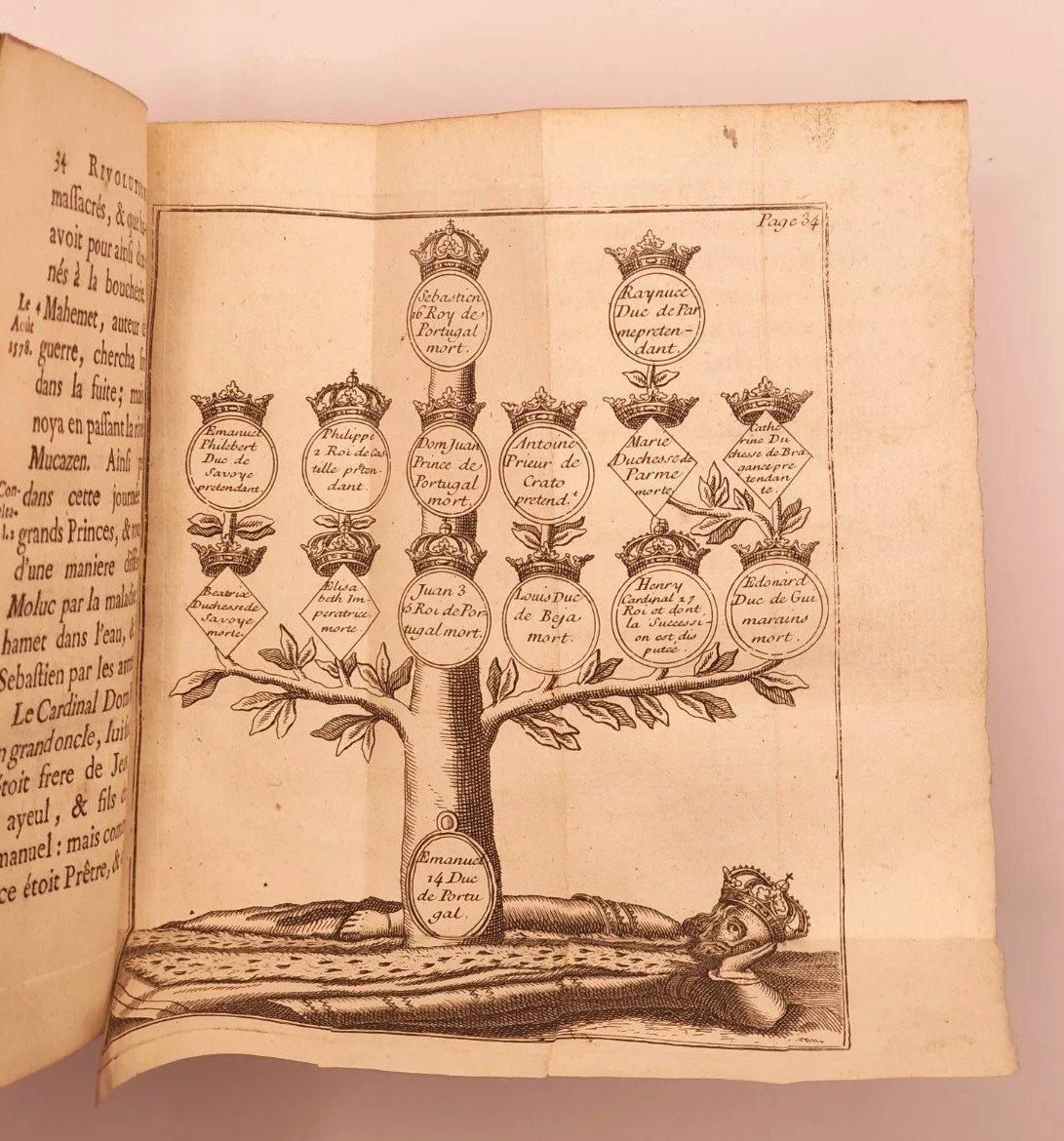
Folding genealogical plate illustrating the royal lineage of the House of Braganza
Text printed in French
Complete example retaining both engraved elements
Moderate wear to binding consistent with age
Context
The Portuguese Restoration of 1640 marked a decisive moment in Iberian and European history. After sixty years of dynastic union with Spain, Portuguese nobles and political leaders revolted against Spanish authority and proclaimed João IV of the House of Braganza as king. This act restored Portuguese sovereignty and initiated a long struggle to secure independence.
Vertot’s history belongs to a broader Enlightenment tradition in which historical writing aimed not only to record events but also to interpret them for contemporary readers. His works on revolutions and political upheavals were widely read throughout the eighteenth century and translated into multiple languages. They combined narrative drama with moral and political reflection, making them popular among both scholars and educated general audiences.
Significance
Today, Révolutions de Portugal stands as an example of early modern historical writing that helped shape European understanding of political change. Beyond its textual importance, the book’s engraved frontispiece and genealogical chart visually situate the narrative within the dynastic history of the Portuguese crown.
As an eighteenth-century volume preserved in its original binding, this edition offers both historical and material interest. It reflects the period’s printing practices, the continued circulation of influential historical narratives, and the enduring fascination with the rise of the Braganza dynasty and Portugal’s return to independence.
Introduction
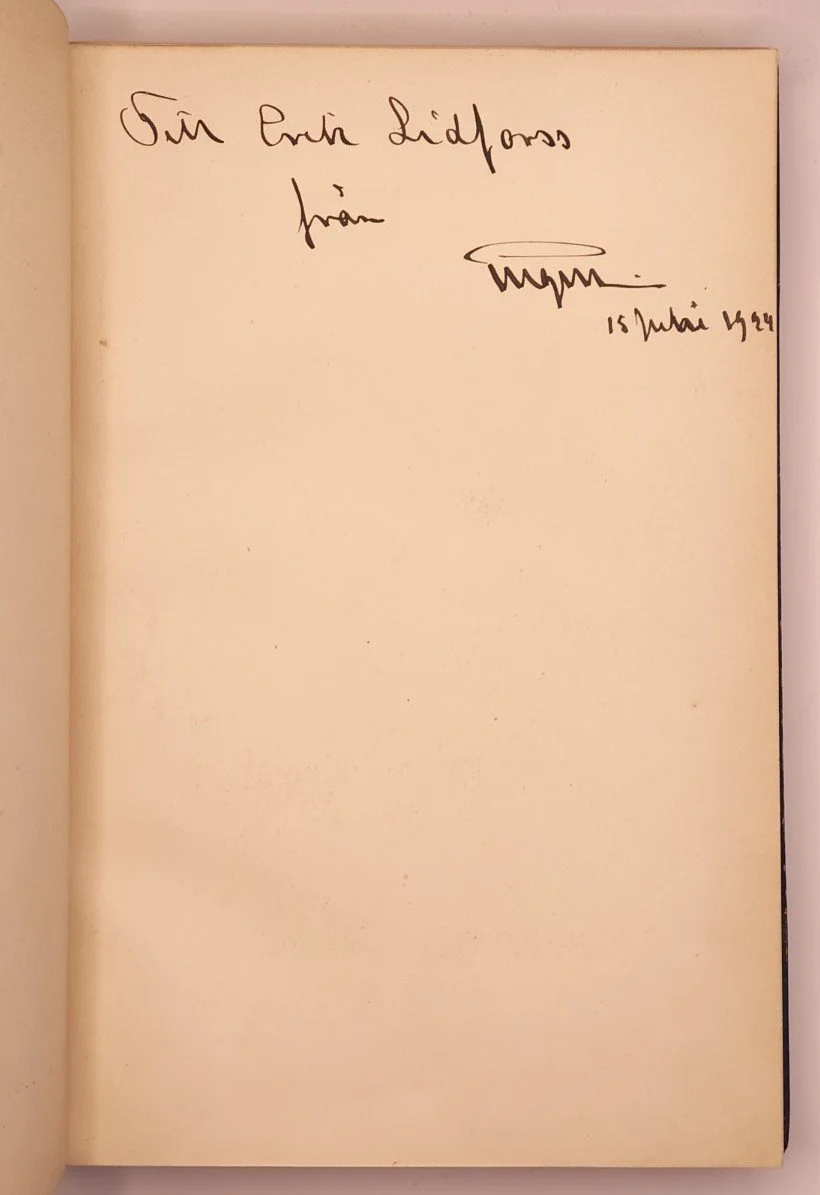
Våra Minnen is a privately printed Swedish volume intimately connected to the early life and artistic development of Prins Eugen. This particular copy carries a personal inscription dated 15 June 1924:
“Till Erik Lidforss från Eugen.” (To Erik Lidforss from Eugen)
The recipient was almost certainly Erik Lidforss, the Swedish author, translator and member of the Royal Swedish Academy of Music. The informal tone of the inscription strongly suggests personal acquaintance rather than ceremonial presentation. The book thus stands as a direct witness to the cultural networks that linked Swedish royalty with the country’s intellectual elite during the early twentieth century.
Physical description
Stuttgart: Deutsche Verlagsanstalt, 1886
Privately printed, not issued for the general book trade
Large octavo format
Contemporary half calf over marbled boards
Gilt lettering to spine
Illustrated with photographic plates
Autograph inscription in ink by Prince Eugen, dated 15 June 1924
Binding sound, minor rubbing to extremities
Interior clean with light age toning
Context
Våra Minnen was produced for limited private circulation rather than commercial sale, enhancing its exclusivity. The volume relates to the youthful experiences of the princely brothers and reflects an early phase in Prince Eugen’s artistic and personal formation.
By 1924, both Prince Eugen and Erik Lidforss were established figures within Sweden’s cultural life. Lidforss, active in literary and musical circles and elected to the Royal Swedish Academy of Music in 1917, belonged to the same cultivated milieu in which Prince Eugen moved as artist, patron and public personality. The inscription therefore situates this copy within a refined intellectual and artistic network rather than within a merely official royal context.
Significance
This copy transcends the category of a signed book. It is an association copy that unites a Swedish prince and prominent cultural figure in a single object. The clarity and intimacy of the inscription enhance its documentary value.
For collectors of Scandinavian cultural history, royal provenance, or artist-related material, this volume offers a compelling convergence of monarchy, literature and art. It represents not only the memory of princely youth, but also the enduring connections that shaped Sweden’s cultural landscape in the early twentieth century.
Introduction
Printed in Paris between 1745 and 1749, this mid-eighteenth century edition of Jean Baptiste Massillon’s sermons represents the enduring authority of one of France’s most celebrated ecclesiastical orators. Massillon, Bishop of Clermont and member of the Académie Française, was renowned for the clarity, moral gravity, and psychological insight of his preaching. His sermons, delivered before the court of Louis XV, secured his reputation as one of the defining voices of French sacred eloquence during the Enlightenment.
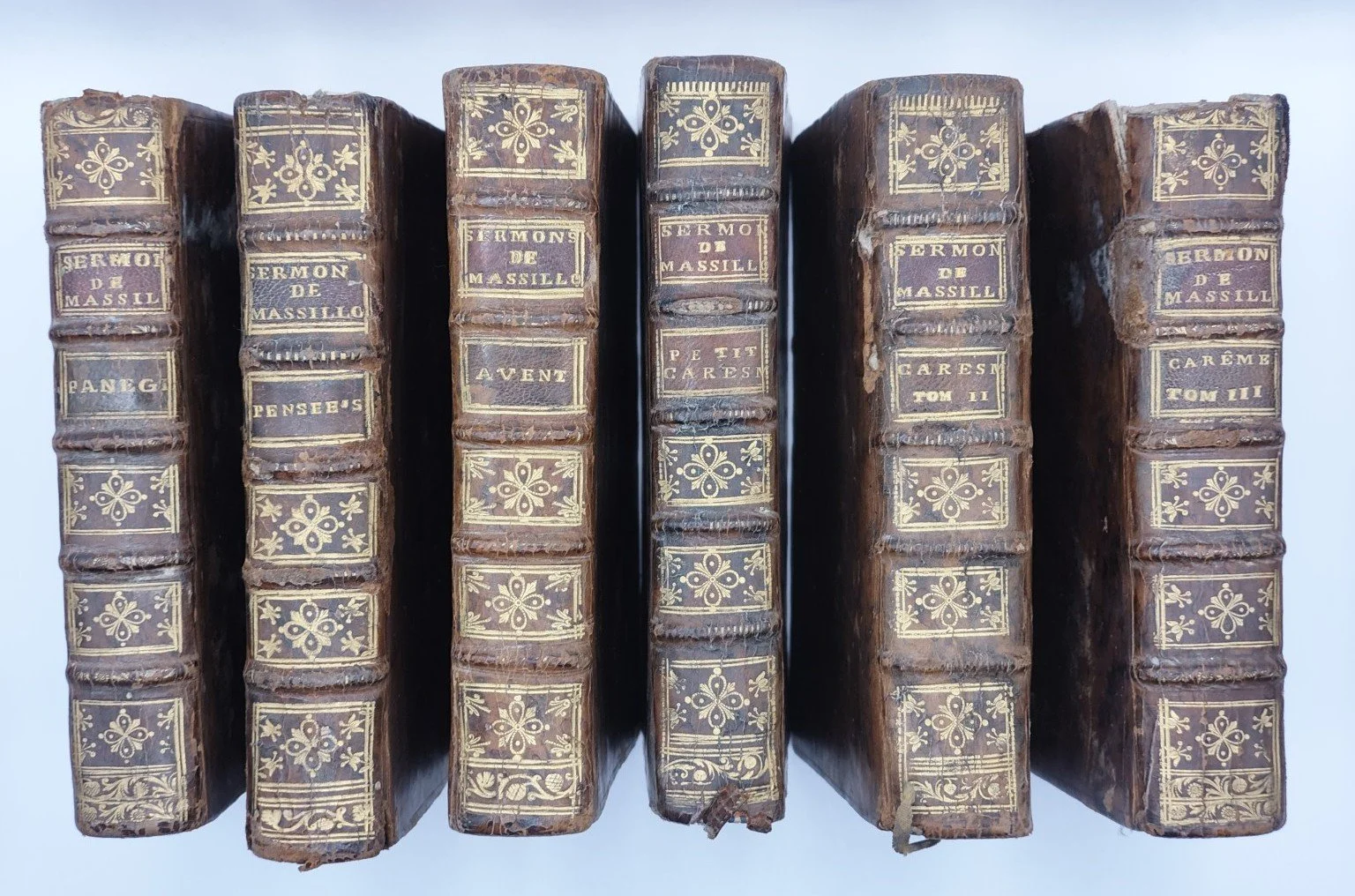
This set gathers several of his principal sermon cycles in a uniform contemporary binding, preserving both their intellectual and material presence.
Physical description
Six volumes, 12mo format
Printed in Paris, 1745 to 1749
Imprint: La Veuve Estienne & Fils; Jean Herissant, Rue Saint Jacques
Contemporary full calf bindings
Gilt-tooled spines with red morocco spine labels
Includes:
Carême, Tome II
Carême, Tome III
Petit Carême
Avent
Panégyriques
Sermons sur différents sujets de morale et de piété
Carême Tome I not present
General rubbing and wear to the bindings consistent with age
Text generally clean and structurally sound
Context
Jean Baptiste Massillon emerged as a central figure in early eighteenth-century French religious life. His preaching was distinguished by its introspective moral analysis and refined rhetorical structure, qualities that appealed both to courtly audiences and to the broader reading public.
The Paris presses of the Estienne family and Jean Herissant, located on the historic Rue Saint Jacques, were among the most important theological printers of their time. By the mid-eighteenth century, Massillon’s sermons were firmly established as canonical texts of Catholic eloquence and continued to be reissued for devotional, clerical, and scholarly readership.
This edition belongs to that period of consolidation, when his works were circulated not merely as sermons but as enduring literary texts.
Significance
Beyond their theological substance, these volumes embody the intellectual culture of the French Enlightenment, where moral philosophy, rhetoric, and religion intersected. Massillon’s ability to address power directly while maintaining spiritual authority made him a singular voice in the court of Louis XV.
As a physical object, the set retains the aesthetic integrity of eighteenth-century Parisian book production. The uniform calf bindings, gilt spines, and compact format give the series both scholarly weight and decorative presence.
Although incomplete in the Carême sequence, the collection remains a coherent and historically resonant survival from the great age of French sacred oratory.
Introduction
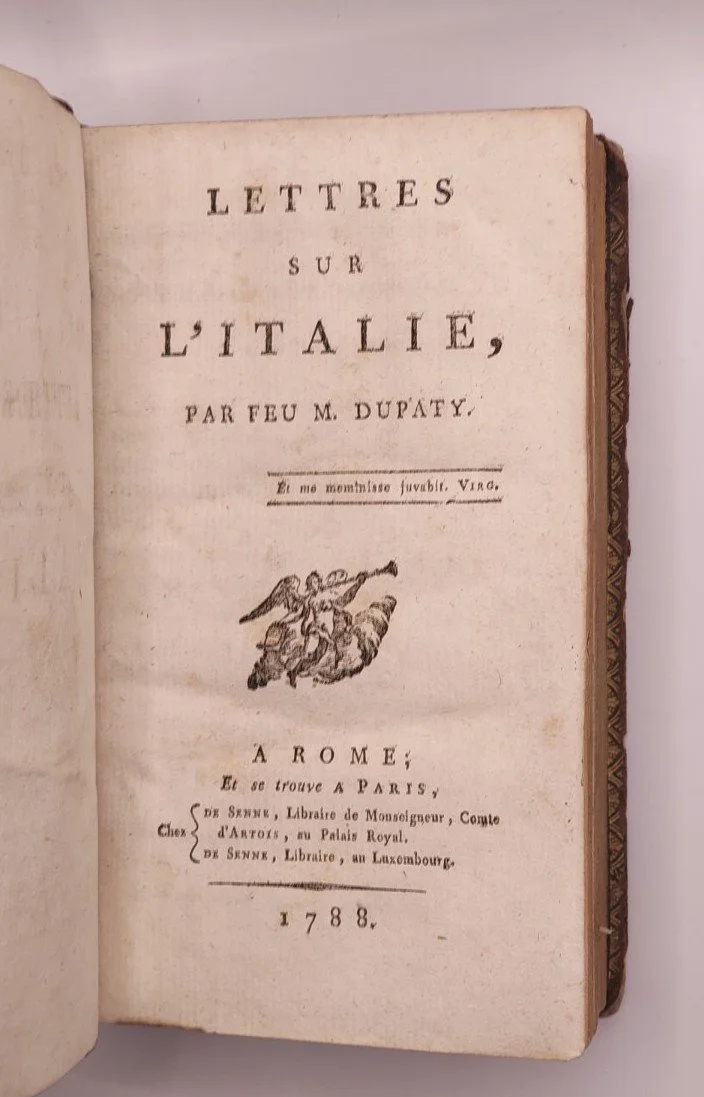
Published in Paris in 1788, Lettres sur l’Italie by Charles-Marguerite-Jean-Baptiste Dupaty offers a refined Enlightenment perspective on Italy at the threshold of modernity. Written in epistolary form, the work blends travel narrative, moral reflection, and social observation, presenting Italy not as a static repository of classical ruins but as a living cultural and political landscape. Dupaty’s letters belong firmly to the intellectual tradition of the Grand Tour, yet they are marked by a personal, analytical voice shaped by the ideals of reason, reform, and empirical observation.
Physical Description
12mo volume
Contemporary French calf binding with gilt double fillet borders
Spine richly gilt in compartments, with red morocco title label
Marbled endpapers
Edges gilt
Printed in Paris, 1788
Complete and textually sound
Period library stamp present on one leaf
Binding worn with age, including rubbing and surface loss to boards and spine, but structurally intact
Interior clean with expected toning and light age related spotting
Context
Dupaty was a magistrate and man of letters whose travels were informed by Enlightenment values rather than antiquarian nostalgia alone. His Italian journey took place during a moment of profound tension in Europe, on the eve of the French Revolution. As such, Lettres sur l’Italie reflects a transitional mindset, balancing admiration for Italy’s artistic and intellectual heritage with criticism of its political institutions, legal systems, and social inequalities. The epistolary format allows Dupaty to move fluidly between description and reflection, combining first hand observation with broader philosophical inquiry.
Significance
This work stands as a compelling example of late eighteenth century travel literature, where the Grand Tour becomes a vehicle for social critique rather than mere cultural consumption. Lettres sur l’Italie is significant for its clear Enlightenment voice, its contribution to Franco Italian cultural exchange, and its insight into how educated Europeans understood Italy just before the revolutionary reshaping of Europe. In its original binding, the volume also serves as a tangible artifact of educated travel, reading, and reflection in the final years of the Ancien Régime.
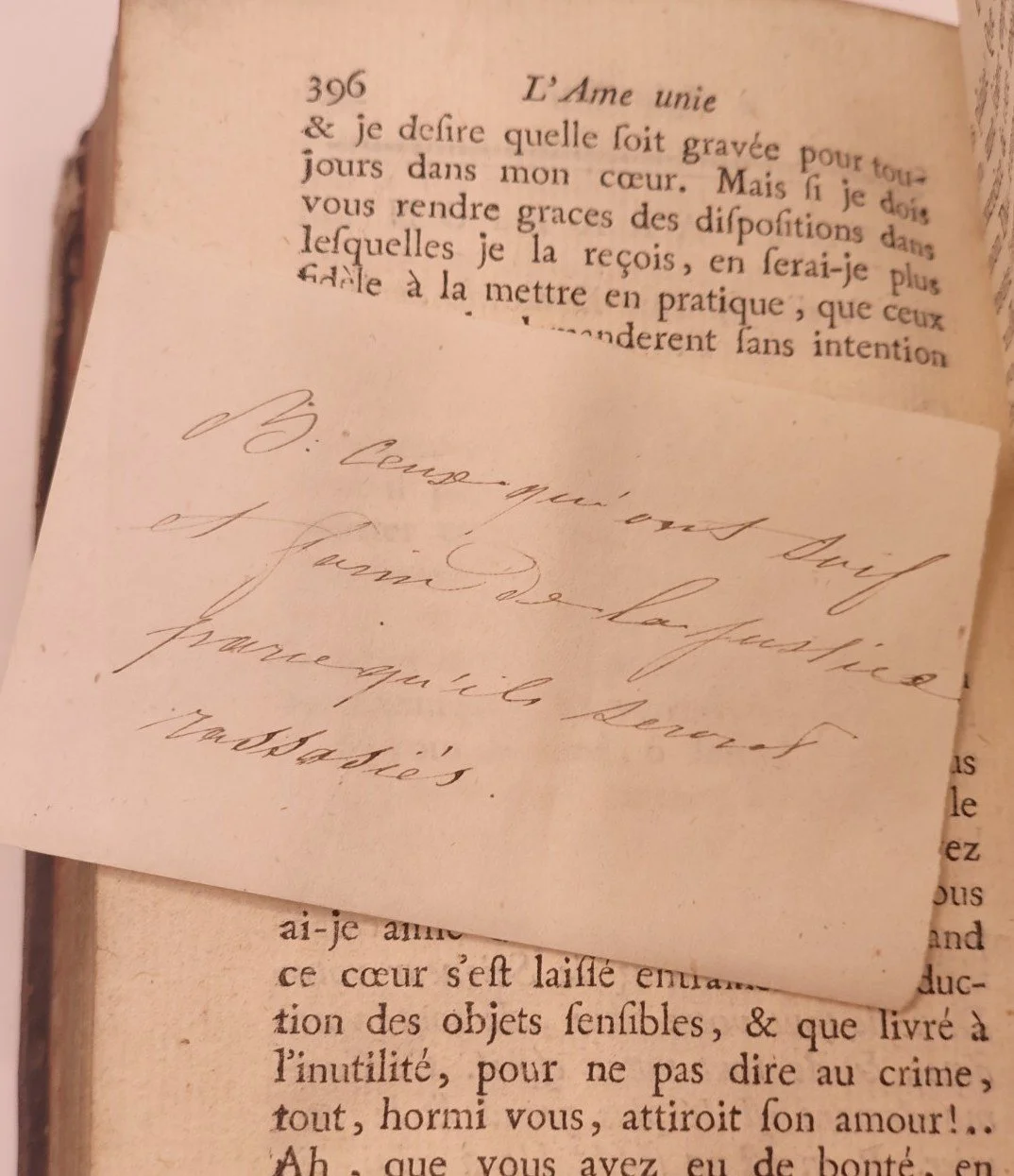
Introduction
This two-volume devotional work, L’Âme Unie à Jésus-Christ dans le Très-Saint Sacrement de l’Autel, was published in Paris in 1781 as a posthumous text by Madame Poncet de la Rivière, Comtesse de Carcado. Conceived for sustained Eucharistic devotion, the book belongs to a late eighteenth-century tradition of French Catholic lay spirituality that emphasised structured prayer, meditation, and preparation for Communion throughout the liturgical year.
The present set is distinguished not only by its completeness and contemporary binding, but also by the survival of devotional material preserved within the volumes. Printed holy cards, feast-day slips, devotional prints, and a handwritten note together document how the book continued to function as a living object of faith well into the nineteenth century.
Physical Description
Title:L’Âme Unie à Jésus-Christ dans le Très-Saint Sacrement de l’Autel
Author: Madame Poncet de la Rivière, Comtesse de Carcado
Publication: Paris, 1781
Edition: First published edition
Format: Two volumes
Binding: Contemporary full leather bindings, uniformly executed
Typography: Clear eighteenth-century French type with ornamental headpieces
Contents: Complete textblocks in both volumes
Condition: General age-related wear to bindings, including rubbing and softened edges; one small area of paper wear to a single leaf; light to moderate toning and occasional spotting consistent with age
Additional material: Group of loose devotional ephemera preserved within the volumes, including printed holy cards, feast-day slips, devotional prints, and a handwritten dedication note quoting Matthew 5:6 (“Ceux qui ont faim et soif de la justice, parce qu’ils seront rassasiés”), written in a contemporary cursive hand.
Context
Works of this kind were intended for repeated, attentive reading rather than occasional consultation. Arranged according to Sundays and major feasts, the text guided readers through cycles of reflection tied to the sacrament of the Eucharist. Such books played a central role in the devotional life of lay Catholics in late Enlightenment France, particularly among women and members of confraternities.
The preserved ephemera point to continued use across generations and suggest an organised devotional or confraternal environment rather than casual later additions. Together, text and inserts illustrate how printed books, small devotional prints, and handwritten notes functioned collectively within everyday religious practice.
Significance
This set offers more than a devotional text. It preserves material evidence of lived Catholic spirituality across the late eighteenth and nineteenth centuries. The combination of a first-edition devotional work, contemporary bindings, and accumulated devotional ephemera provides insight into how religious books were used, augmented, and retained within personal and communal contexts.
As an object, the work stands at the intersection of text, practice, and memory. It is representative of French Catholic devotional culture on the eve of the Revolution, while also bearing witness to the continuity of religious life in the decades that followed.
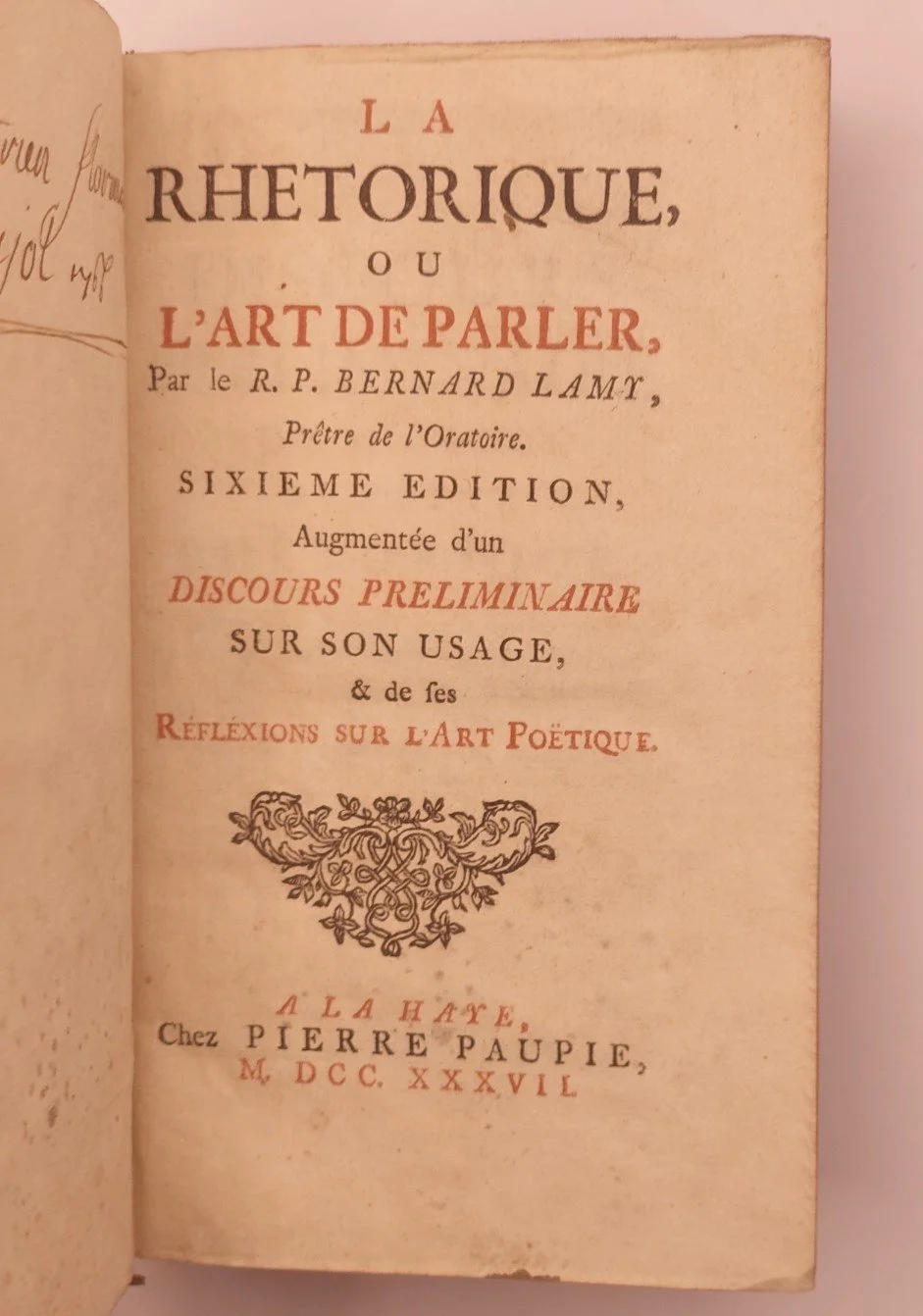
Introduction
This copy of La Rhétorique, ou l’Art de parler by Bernard Lamy, printed at La Haye in 1737, represents one of the most influential rhetorical treatises of the French Enlightenment. Lamy’s work bridges classical rhetoric and early modern theories of language, persuasion, and reason, and remained in continuous pedagogical use throughout the eighteenth century.
The volume bears a contemporary ownership inscription reading “Adrien Flourmond, Poujol 1766”, situating the book within a concrete intellectual milieu less than three decades after publication. This personal mark anchors the text in lived use rather than abstract transmission, reinforcing its role as a working manual for thought, speech, and instruction rather than a purely theoretical artifact.
Physical Description
Title: La Rhétorique, ou l’Art de parler
Author: Bernard Lamy
Language: French
Date: 1737
Place of printing: La Haye
Printer / Publisher: Pierre Paupie
Edition: Sixth edition
Format: Single volume
Binding: Contemporary full leather, gilt spine compartments with floral tools
Typography: Roman type, structured chapters with formal divisions and headings
Provenance: Early manuscript ownership inscription “Adrien Flourmond, Poujol 1766”
Condition: General age wear to binding, surface abrasions and toning, scattered spotting to textblock, minor edge wear; internally complete and structurally sound
Context
First published in the late seventeenth century, La Rhétorique became one of the standard rhetorical textbooks of the Enlightenment. Lamy, an Oratorian priest and philosopher, sought to reconcile classical rhetorical tradition with Cartesian clarity and moral reasoning. His approach emphasizes persuasion as an ethical and intellectual act grounded in clarity of thought, precision of language, and disciplined structure.
By the time of this sixth edition, the work had secured its place in educational curricula across France and beyond, circulating among clerics, teachers, students, and lay readers engaged in law, theology, and letters. Its continued reprinting reflects both its pedagogical utility and its adaptability to changing intellectual climates.
Significance
The importance of this volume lies not only in its textual content but also in its material and historical specificity. The survival of a named eighteenth century owner situates the book within an identifiable chain of use, transforming it from a neutral instructional text into a witness of rhetorical practice at the individual level.
As a later Enlightenment edition in contemporary binding, the book exemplifies how rhetorical theory was preserved, studied, and physically handled in everyday intellectual life. It stands as a representative artifact of eighteenth century educational culture, where rhetoric functioned as a foundational discipline shaping discourse, judgment, and civic participation.
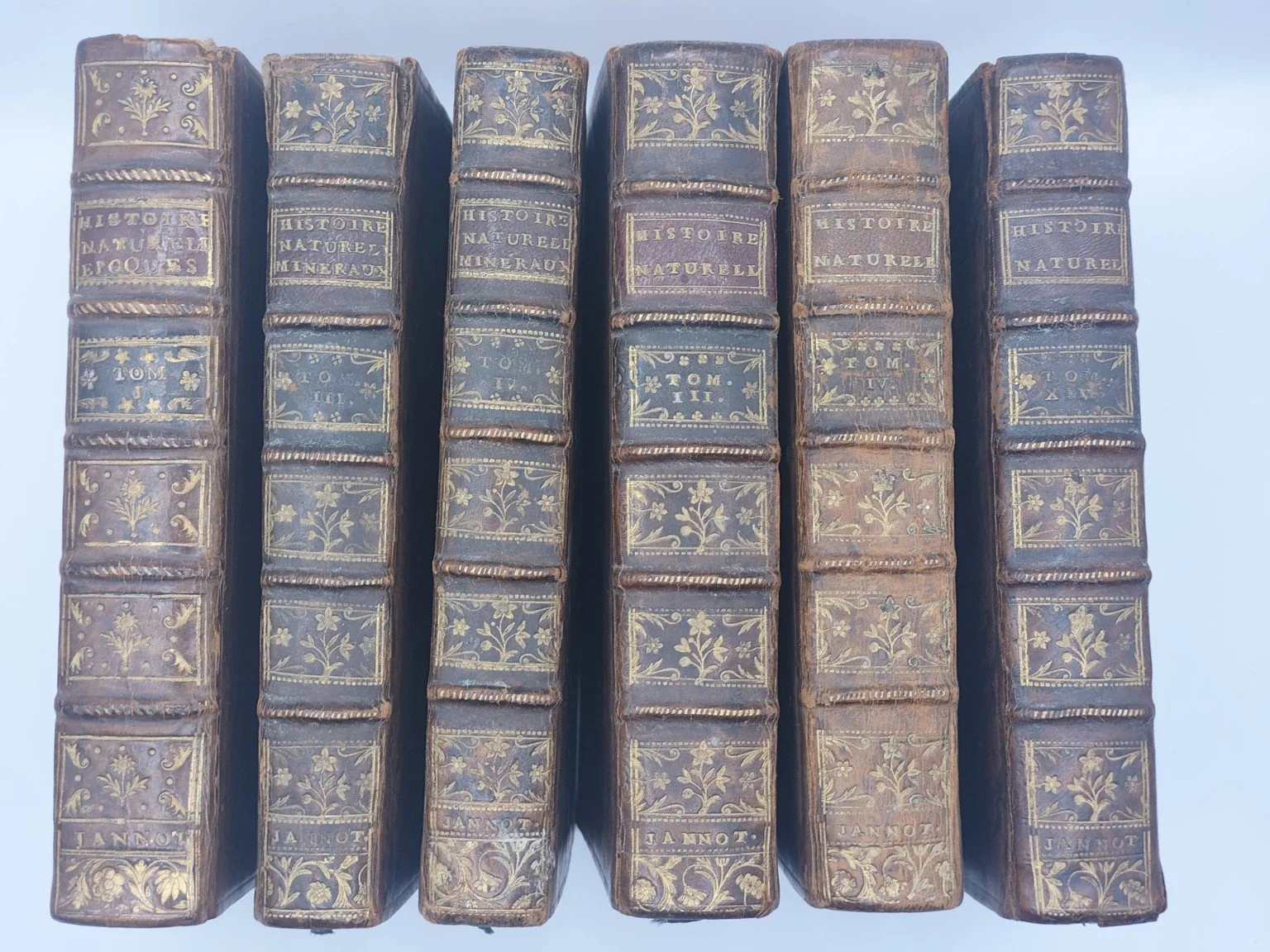
Buffon’s Histoire naturelle stands as one of the most ambitious intellectual undertakings of the Enlightenment. Conceived as a comprehensive account of the natural world, it brought together observation, philosophy, and emerging scientific method, and exerted a formative influence on natural history, geology, and the life sciences well into the nineteenth century.
The present offering is a coherent ensemble of six eighteenth-century volumes drawn from both the main series and the Suppléments. Though fragmentary, the group represents a meaningful cross section of Buffon’s project, with material devoted to the structure of the Earth, mineralogy, and the systematic description of nature. It reflects the work in active use, rather than as a later assembled remnant.
All volumes are preserved in uniform contemporary full calf bindings, clearly executed as a set in the period. The bindings display a warm and honest patina, with some rubbing and wear to the spines consistent with age and use. The interiors remain clean and legible, with light foxing only and no structural defects.
The illustrated content is complete for the volumes present. Tome Troisième of the main series contains its three engraved figures, all present and well printed. Supplément, Tome Neuvième includes its single engraved illustration, likewise complete and intact. No fold-out plates are required or called for in these specific volumes.
Collation and technical details
Title: Histoire naturelle, générale et particulière
Author: Georges-Louis Leclerc, comte de Buffon
Printing: Paris, Imprimerie Royale, 1769–1788
Six volumes, 12mo, approximately 17 cm in height.
Main series
Tome Troisième, illustrated with three engraved figures.
Tome Treizième
Tome Quatorzième
Suppléments
Supplément, Tome Troisième
Supplément, Tome Quatrième
Supplément, Tome Neuvième, illustrated with one undamaged fold-out illustration.
A total of four original copper engravings are present. All illustrations are complete as issued.
Condition
Contemporary uniform calf bindings with age-related wear and patina. Some rubbing and minor loss to the spines. Internally clean and sound, with light foxing consistent with the period. No tears, losses, or repairs observed.
Although not a complete set, this ensemble forms a visually harmonious and intellectually substantial fragment of Buffon’s great work. It offers an authentic eighteenth-century presence, suitable for the collector of early scientific literature, the historian of Enlightenment thought, or the bibliophile seeking a carefully preserved grouping in original condition.
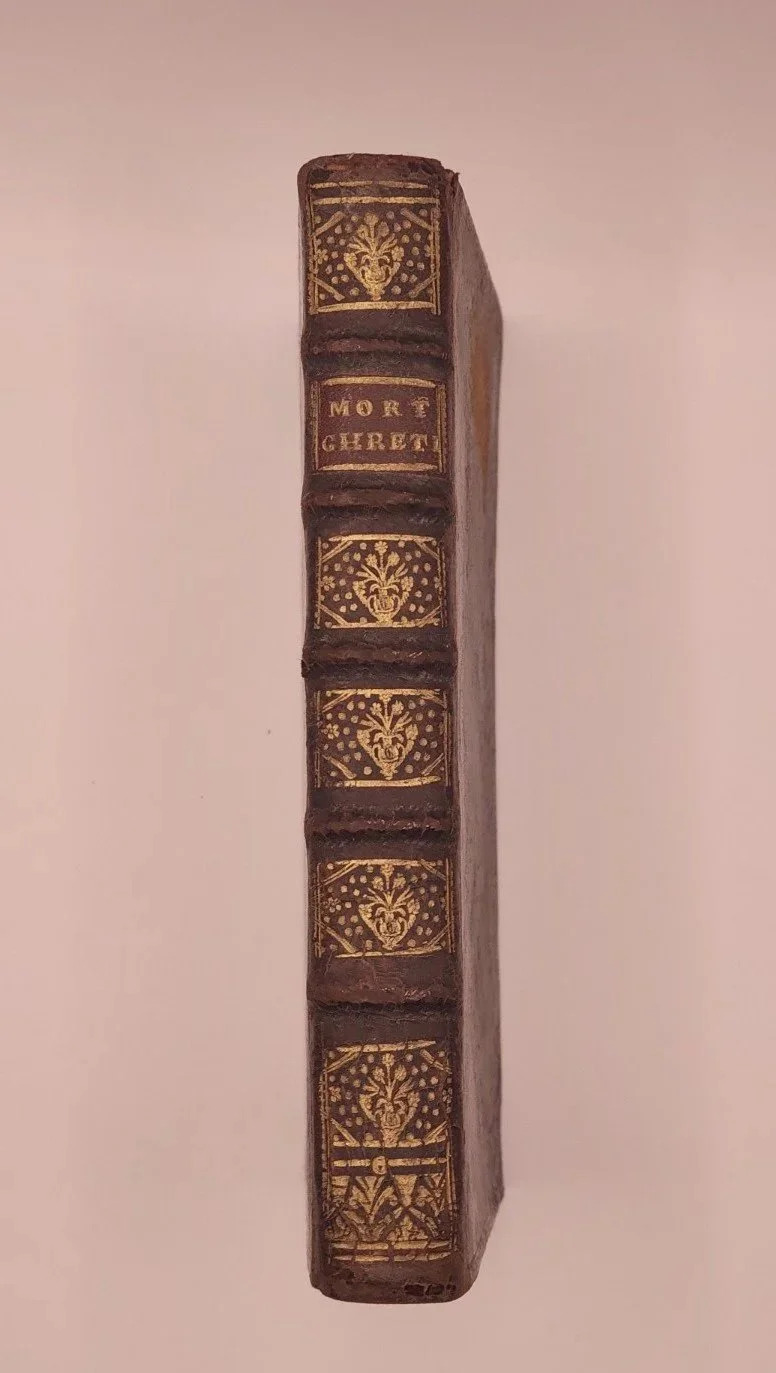
This small devotional book, printed in Paris in 1738, belongs to a long tradition of early modern Christian literature concerned with death not as catastrophe, but as preparation. Le Bonheur de la mort chrétienne proposes an eight day spiritual retreat structured around meditation, self examination, and the acceptance of mortality as a passage rather than an end.
Anonymous in authorship, the work reflects a broader Catholic devotional culture in which texts circulated less as expressions of individual authority and more as practical instruments for inner discipline. The emphasis is not on doctrine alone, but on habit. Reading was meant to be slow, repetitive, and intimate, closely tied to daily spiritual exercise.
The volume survives in its original full calf binding, modest in format yet carefully finished, with gilt decoration to the spine. The leather shows wear, darkening, and surface loss, bearing clear traces of prolonged use. Such wear is not incidental. It speaks to a book that was handled, carried, and returned to over time. Inside, an engraved emblematic frontispiece presents a book and a candle beneath a radiant triangle, a concise visual meditation on knowledge, vigilance, and divine presence.
The preface is addressed to the Duchesse de Grammont, situating the work within the devotional life of the French aristocracy while underscoring its intended seriousness and moral weight. Faint contemporary manuscript markings in the preliminaries add another layer of human presence, reminders that this text once belonged to a particular reader whose engagement has left a quiet but enduring mark.
As an object, the book stands at the intersection of text, ritual, and material culture. It is not rare in the sense of uniqueness, but it is increasingly uncommon in its survival as a complete and expressive witness to how books were used to structure thought, emotion, and spiritual time in the early eighteenth century.
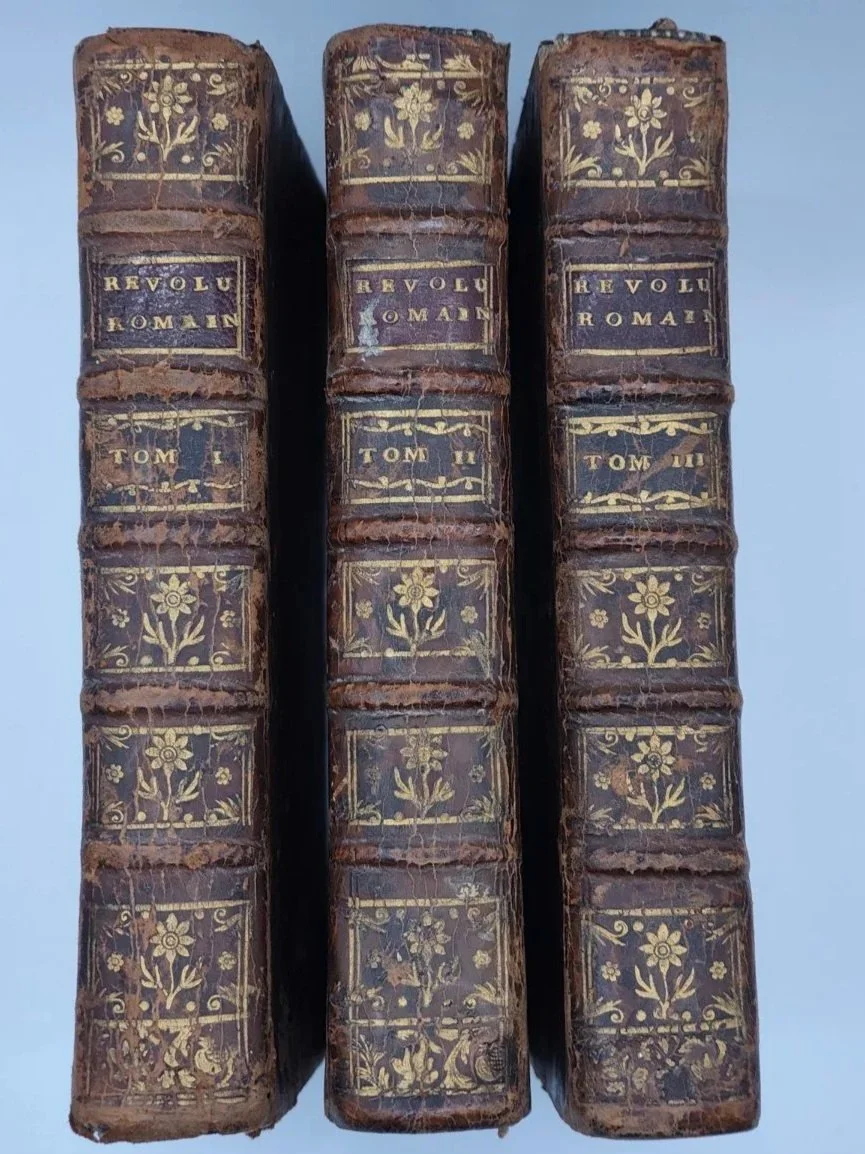
This complete three volume set of Histoire des révolutions arrivées dans le gouvernement de la République romaine was published in Paris in 1732 and represents the expanded second edition of one of the most widely read political histories of the early Enlightenment. Its author, Abbé de Vertot, was among the most influential historical writers of his generation, admired for a style that privileged narrative coherence and political insight over archival accumulation.
Vertot’s Rome is not antiquarian in the narrow sense. The Roman Republic is treated as a living political organism, shaped by ambition, civic virtue, faction, and collapse. Ancient history here functions as a mirror for early eighteenth century Europe, where questions of sovereignty, republicanism, and political decay were anything but abstract. For contemporary readers, Vertot’s work offered instruction as much as information.
The present set is bibliographically complete, with correct collation throughout:
Volume I, 421 pages; Volume II, 488 pages; Volume III, 432 pages.
No plates or maps were issued with this edition.
The volumes are preserved in contemporary full calf bindings, with mottled boards, richly gilt spines, and marbled endpapers. The bindings show honest wear, consistent with prolonged use in a learned private library. The text blocks are sound, with age toning and scattered spotting, and the set remains structurally intact.
As an object, this work embodies the way history was read, owned, and understood in the eighteenth century. It stands at the intersection of classical antiquity and Enlightenment political thought, valued not only for what it recounts, but for how history itself was shaped into argument and narrative.
A solid and authentic example of French Enlightenment historiography, preserved as a complete contemporary set.
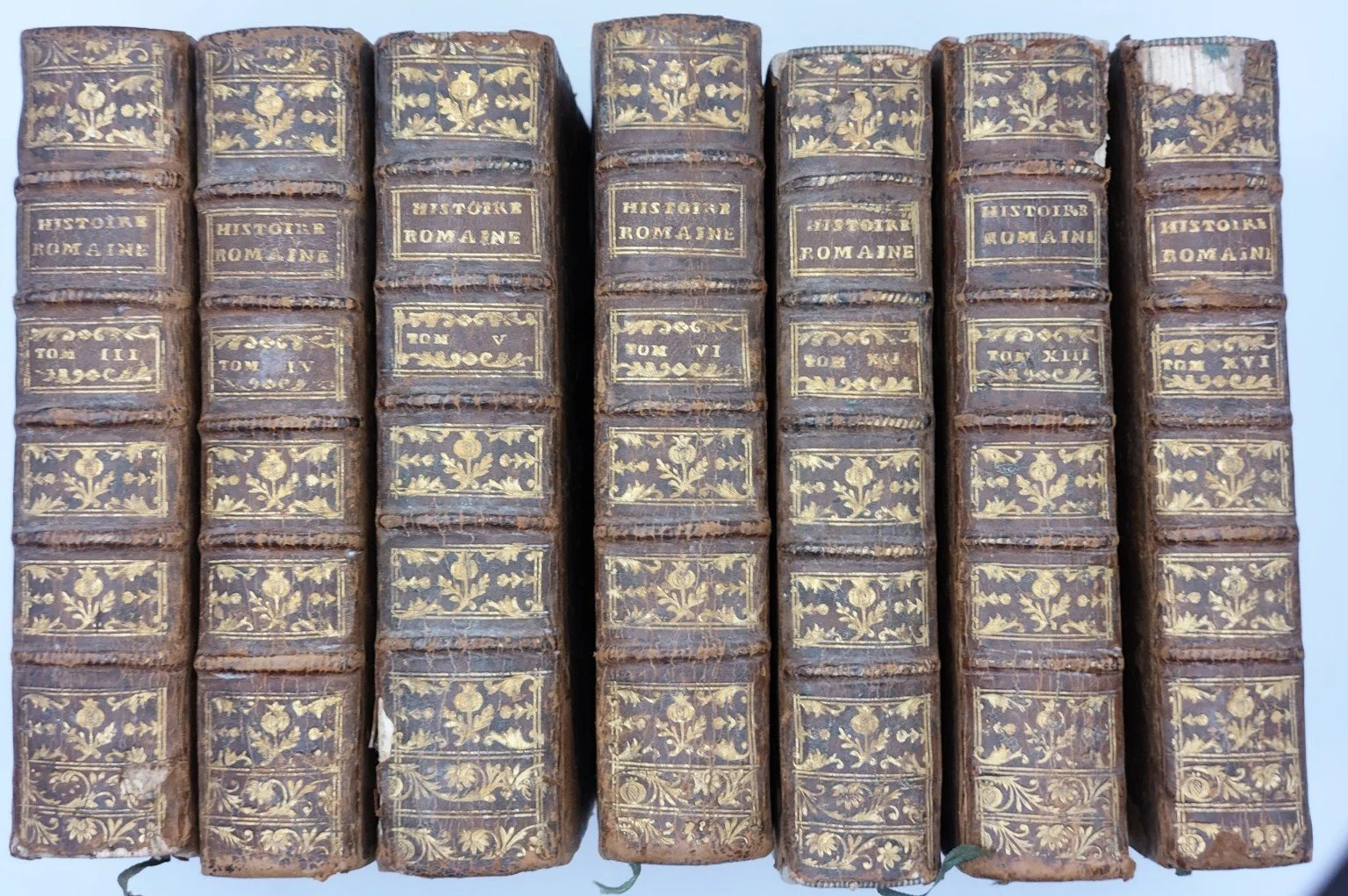
This group of seven volumes forms part of Charles Rollin’s and Crevier’s Histoire Romaine, one of the most influential historical works of the eighteenth century. First published earlier in the century and reissued repeatedly, the work shaped how ancient Rome was read, taught, and morally interpreted throughout the Enlightenment.
Rollin conceived history as a didactic discipline. Rome was not merely recounted as a sequence of events, but presented as a moral and political laboratory, offering examples of civic virtue, ambition, corruption, and decline. For eighteenth-century readers, the Roman Republic served as both model and warning, particularly in an age marked by imperial expansion, absolutism, and growing political unease.
The present collection comprises volumes 3, 4, 5, 6, 12, 13, and 16, published in Paris by the Frères Estienne between 1765 and 1769. Although the set is incomplete, it offers a substantial and representative cross section of the series. Several volumes include engraved maps and folding plans, such as urban layouts and military schemes, reflecting the period’s desire to render antiquity legible through cartography and visual order.
The books are preserved in contemporary full calf bindings with gilt spines and marbled endpapers. The bindings show wear consistent with age and use, bearing the marks of long residence in working libraries rather than decorative collections. As objects, they retain a strong material presence, balancing scholarship with the physical realities of eighteenth-century book production and use.
Full title: Histoire Romaine depuis la fondation de Rome jusqu’à la bataille d’Actium
Author: Rollin, C.; Crevier, JBL.
Printing: Paris, Frères Estienne, 1765–1769. Nouvelle Edition.
Today, Histoire Romaine is read less as modern historiography and more as a document of its own time. It reveals how antiquity was mobilised to think about power, governance, empire, and historical inevitability. In fragmentary form, these volumes speak not only of Rome, but of the Enlightenment’s effort to discipline the past in order to understand the present.
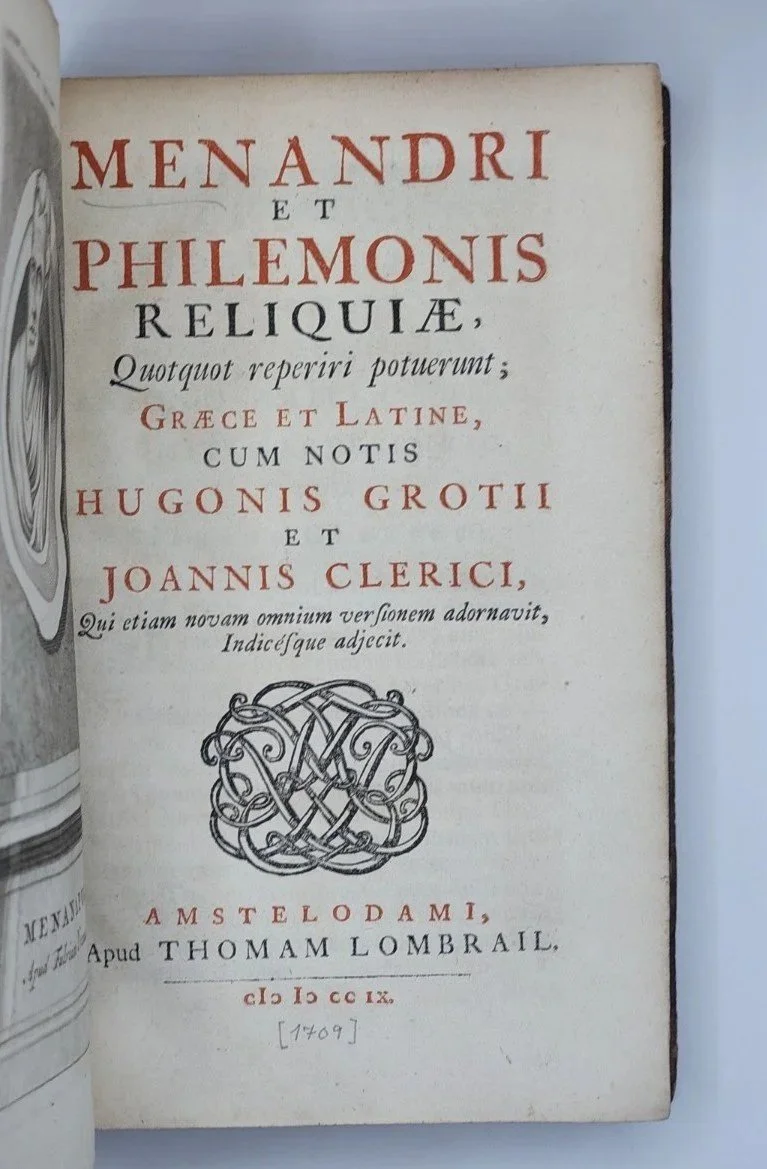
This volume marks a pivotal moment in the history of classical philology. It brings together the surviving fragments of Menander and Philemon as they were known in the early eighteenth century, edited and annotated by two of the most influential figures of the Republic of Letters, Hugo Grotius and Jean Le Clerc. Before the papyrus discoveries of the nineteenth century, this edition constituted the authoritative textual foundation for the study of Greek New Comedy.
Printed in Amsterdam by Thomas Lombrail in 1709, the work presents the Greek text with a facing Latin translation, accompanied by extensive scholarly commentary. The two engraved frontispiece portraits, depicting Menander and Philemon, function both as learned likenesses and as visual affirmations of classical authority within early modern book culture.
The present copy is bound in contemporary full calf, with a richly gilt spine and raised bands. The edges are red speckled, a detail that reflects the book’s original status as a serious scholarly tool rather than a purely decorative object. Former institutional provenance, documented by a duplicate stamp from Uppsala University Library, adds a further layer of intellectual history and recorded use.
Seen as a book, this is more than a textual edition. It is a witness to the way antiquity was transmitted, interpreted, and stabilised before the emergence of modern philology. For collectors of classical literature, humanist scholarship, and early modern book history, this volume represents a concentrated expression of both textual and material significance.
Introduction
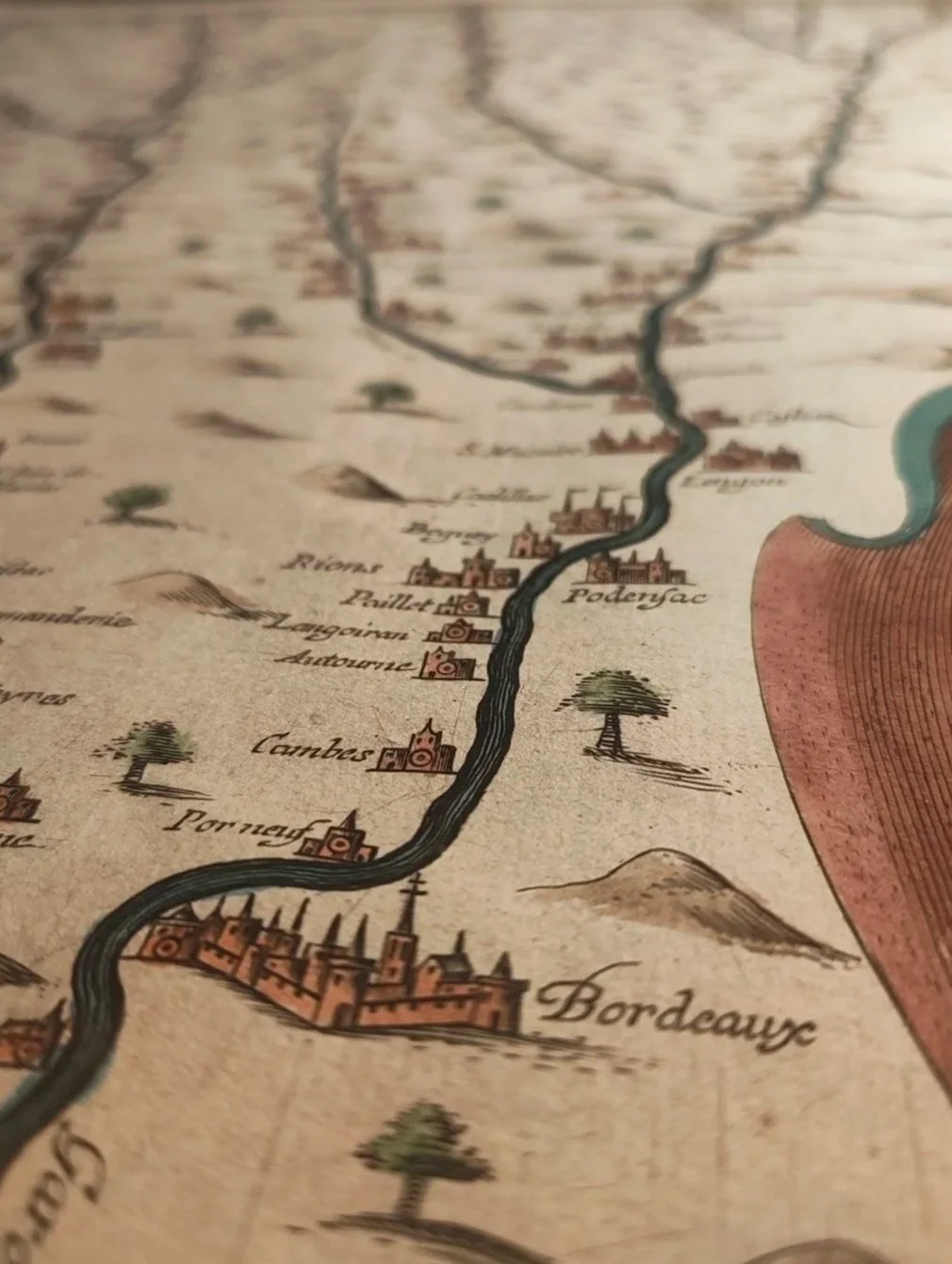
This finely engraved and hand coloured map presents the river system of southwestern France, centered on the Garonne and its tributaries, from the inland regions to Bordeaux. Executed by Jean Le Clerc in 1628, it belongs to the early seventeenth century tradition of decorative French cartography, where geographic precision is combined with heraldic display and careful ornamentation. The map offers not merely a geographic survey, but a visual statement of regional order, jurisdiction, and identity.
Description
Large engraved map on laid paper, with contemporary hand colouring. The river network is depicted vertically, populated with towns, churches, forests, and stylized relief. At lower right, an elaborate cartouche encloses the title and a heraldic shield, with inscription naming Jean Le Clerc as engraver and the date 1628. Compass rose and scale bar are present. The verso is blank. The sheet shows original folds as issued, with visible fold lines, edge wear, and minor losses at margins, consistent with age and use. Overall condition is honest and intact, with strong impression and well preserved colour.
Original Name: Potamographie de la Garonne et des Fleuves qui s’y Rendent
Author: Jean le Clerk
Printing: Paris, 1628
Dimensions: 53×41 cm
Historical context
Jean Le Clerc was active in Paris during a period when French cartography was increasingly oriented toward administrative clarity and internal geography, rather than overseas exploration alone. River maps such as this were essential tools for governance, trade, and military logistics. The Garonne in particular was a vital artery linking the interior of France with the Atlantic world, and Bordeaux emerges here as a focal point of economic and political gravity.
Significance
This map stands as an early visual synthesis of geography, power, and ornament in seventeenth century France. Its appeal lies equally in its cartographic content and its aesthetic presence. As an original example from 1628, it represents a scarce survival from the formative period of French engraved mapping, suitable for both scholarly interest and refined display.
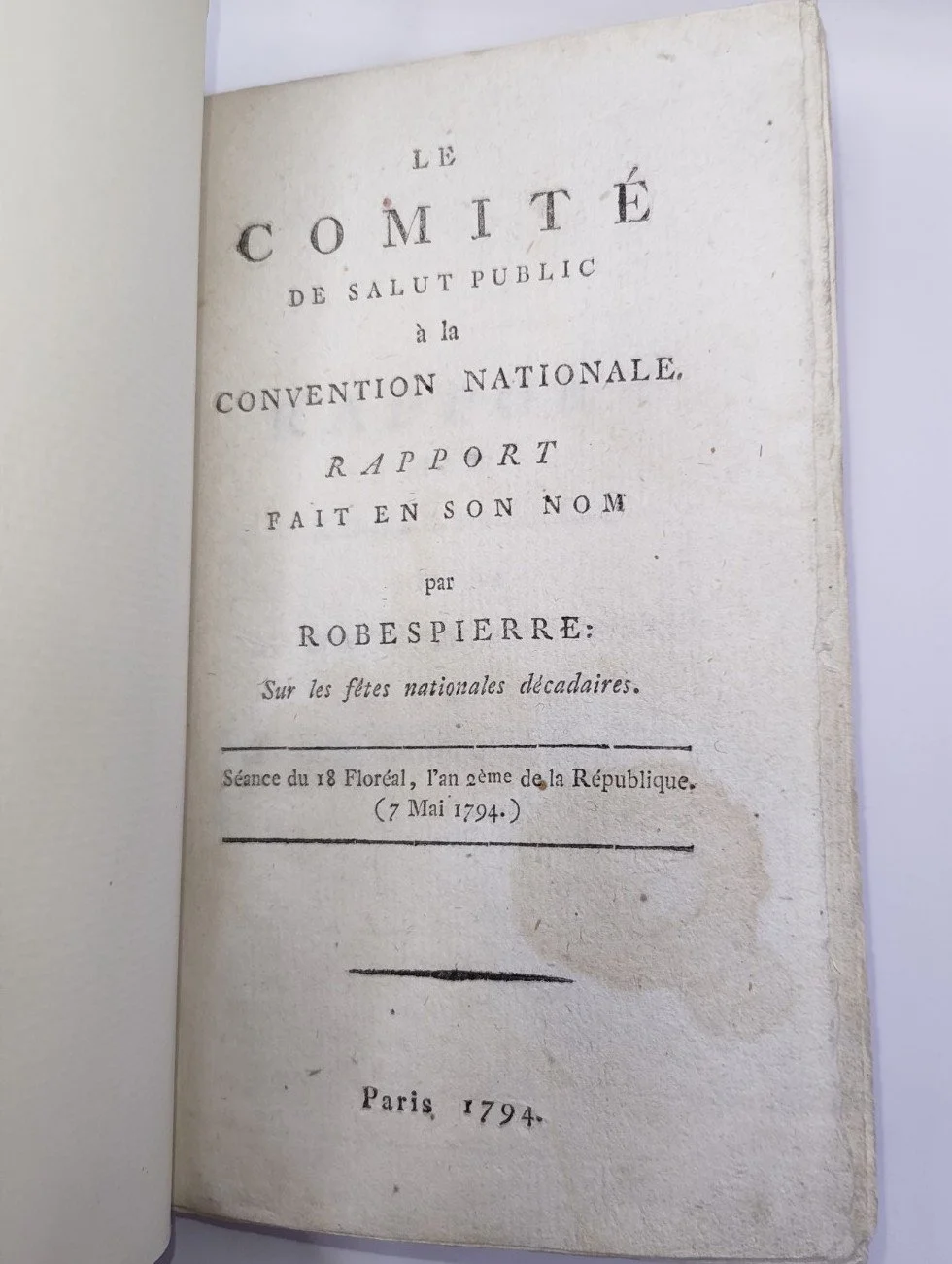
Introduction
This official report, delivered by Maximilien Robespierre to the National Convention in the second year of the French Republic, stands as one of the most revealing documents of the revolutionary attempt to reshape civic life. In it, Robespierre outlines the purpose and structure of the new décadi festivals that were meant to replace the traditional Christian calendar with a sequence of republican ceremonies. The text reflects the ambition to create a moral and civic framework rooted in revolutionary virtue rather than inherited religious forms. It is a rare instance in which the ideological program of the Committee of Public Safety takes on a concrete, ceremonial form, intended for the daily life of citizens.
The present copy is a contemporary printing from 1794, preserved in a later plain paper binding that protects the original text block. There is light staining, including a circular mark on the preliminaries, together with scattered foxing, yet the work remains complete and legible. As a primary document from the most intense phase of the Revolution, it offers a direct view into the construction of republican culture at a moment when political ideals and public ritual were inseparable.
Bibliographical details
Title: Le Comité de salut public à la convention nationale. Rapport fait en son nom par Robespierre
Place: Paris
Date: 1794
Format: Octavo
Pagination: 58 pages
Binding: Later plain paper boards, modern rebinding
Language: French
Condition: Light staining and foxing, one circular stain on preliminaries, text block complete and well preserved
Provenance: Ex Libris Per-Olof Engsner
Significance
As a testimony to the revolutionary effort to redefine the social fabric through public ritual, this report occupies a distinctive place in the history of political culture. It illustrates how the Committee of Public Safety understood the relationship between morality, collective identity and state authority. The pamphlet’s survival underscores the gravity with which such texts were produced and circulated during a year when the Revolution sought to establish a new civic order. For historians of eighteenth century France, for collectors of revolutionary printing and for those interested in the creation of republican symbolism, this document represents an essential primary source.
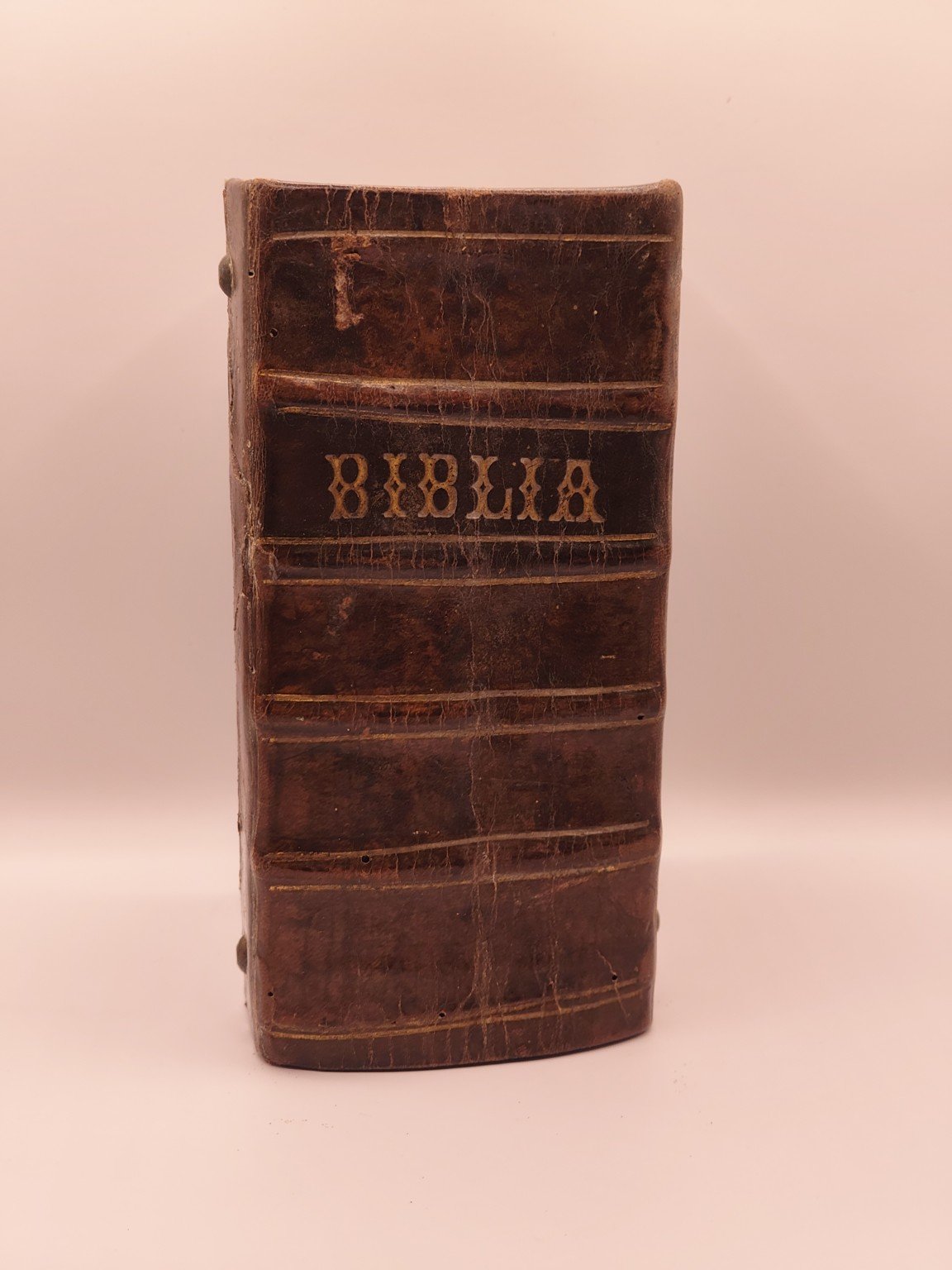
Introduction
This Swedish Bible, printed in Gothenburg in 1764 by Johan Georg Lange, stands as a tangible witness to the religious life and material culture of late eighteenth century Sweden. The substantial full leather binding with its brass clasps and bosses was made to endure generations of use, and the surviving inscriptions reveal that it did precisely that. Names and dates in several hands mark the book’s passage through households where Scripture formed part of the rhythm of everyday life. The volume presents itself not merely as a religious text but as an inherited object shaped by time, devotion and repeated handling.
Physical Description
Title: Biblia. Thet är All Then Heliga Schrift
Language: Swedish
Date: 1764
Place of printing: Gothenburg
Printer: Johan Georg Lange
Edition: Third edition
Binding: Contemporary full leather with original brass clasps and corner fittings
Typography: Black letter type in double column with customary chapter summaries
Provenance: Multiple handwritten ownership notes from the eighteenth and nineteenth centuries
Condition: General wear to binding, scuffing and age toning throughout, scattered spotting, traces of handling, minor worming to boards, textblock complete and sound
Context
Biblical printing in eighteenth century Sweden was both a religious and a civic enterprise. Printers such as Johan Georg Lange contributed to a broader project of supplying durable and legible editions for public and domestic use. Large format Bibles in protective bindings were intended not only for reading but also for preservation, functioning as household anchors for liturgical reading, family records and moral instruction. This volume embodies that dual purpose. The weight of the binding, the brass fittings and the fraktur type all evoke a culture in which the material form of the book was understood as part of its authority.
Significance
Beyond its textual content, the importance of this Bible lies in its accumulated history. The inscriptions on the endpapers create a chain of provenance that transforms the book into a record of personal and familial memory. Wear on the binding and toning of the paper give it a character shaped by continuous use rather than by neglect. As a historical artefact it offers insight into the circulation of sacred texts in provincial Sweden and the forms of craftsmanship that supported such circulation. It stands as a representative example of Swedish eighteenth century Bible printing and as a surviving object of lived devotion.
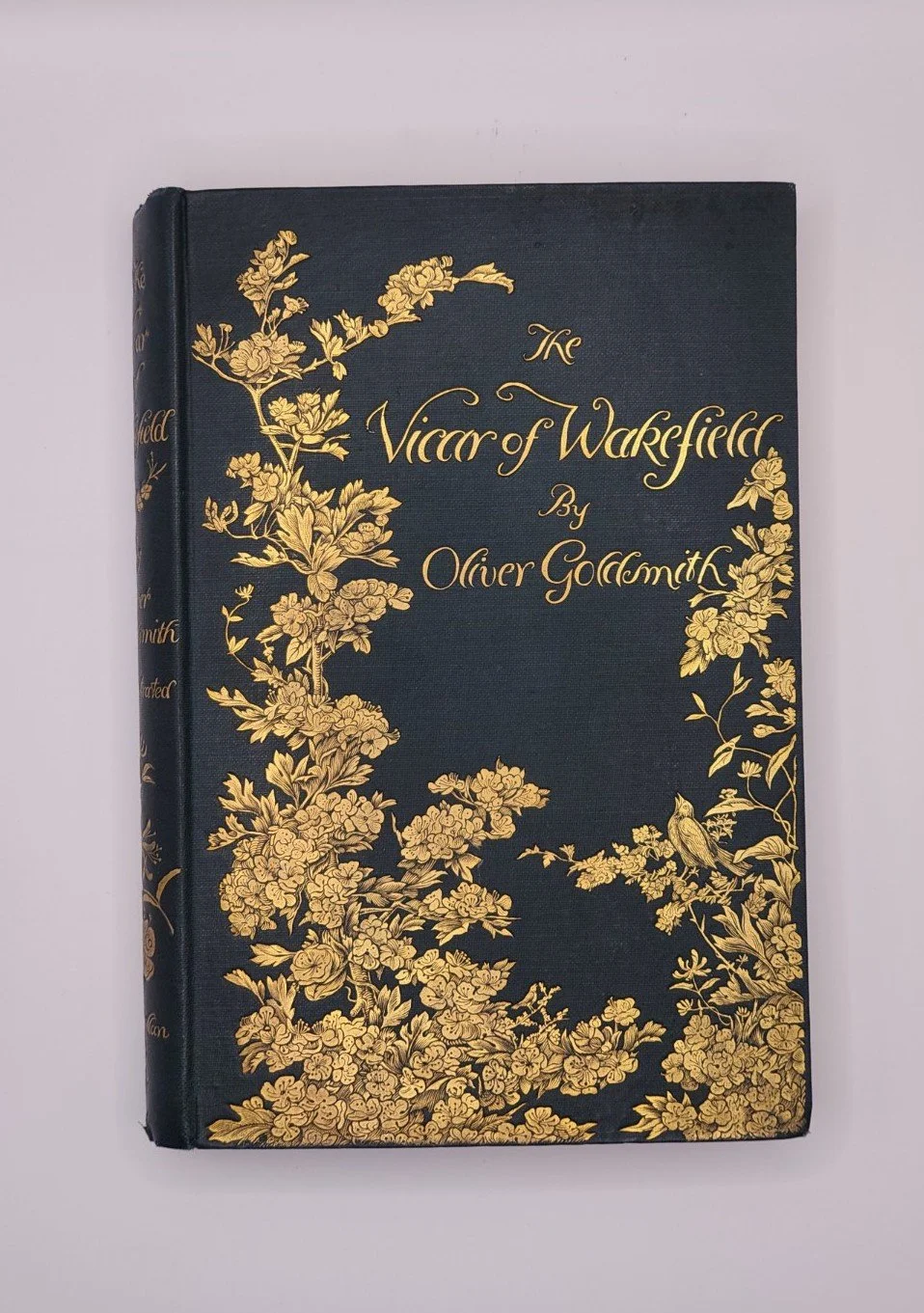
Introduction
This 1890 edition of The Vicar of Wakefield stands at the threshold of the Golden Age of illustration. It is the first collaboration between Oliver Goldsmiths classic eighteenth century novel and the young Irish illustrator Hugh Thomson, whose decorative vision would soon come to define the illustrated gift book of the fin de siecle. The result is a volume that presents a beloved narrative through a newly imagined visual world. The story becomes simultaneously pastoral, humorous and ornamental, filtered through the instantly recognisable elegance of Thomsons hand.
The Edition
Macmillan’s 1890 printing inaugurated a series of richly illustrated gift editions that combined fine printing, ornamental cloth bindings and an almost theatrical sense of visual charm. The dark blue cloth is adorned with an abundance of gilt floral motifs that rise and circle around the title, a pattern created specifically for this series. Time has rendered the gold a soft, luminous tone that contrasts beautifully with the depth of the cloth.
Inside, Thomsons illustrations appear not as isolated embellishments but as an integral part of the reading experience. Full page plates present the characters in moments of calm, mischief or domestic ceremony. Smaller drawings weave through the text and settle into its margins. They create a gentle rhythm that shifts the novel from simple narrative into visual performance. The printed dedication to Austin Dobson, placed at the opening of the book, underlines its character as an artistic partnership between writer, illustrator and poet.
Historical Context
The appearance of this edition marks an important development in British book design of the late nineteenth century. Publishers such as Macmillan sought to rejuvenate classic literature by presenting it in handsome new formats that appealed to collectors and gift buyers. Thomson emerged as one of the movement’s most influential illustrators, his line work blending Regency nostalgia with modern decorative clarity.
Goldsmith’s novel, with its balance of sentiment and satire, proved an ideal companion for Thomsons vision. The result is a meeting point between eighteenth century literary culture and late Victorian artistic sensibility. This 1890 edition embodies the moment when illustration, binding design and text were conceived as a unified aesthetic whole.
Condition and Provenance
The present copy retains its richly gilt binding with pleasing brightness and a sound internal structure. The pages are clean, with only light evidence of careful use. A handwritten ownership note dated London 1949 adds a quiet record of the book’s passage through time. It remains an evocative example of Macmillan’s early illustrated productions and an attractive representative of Thomsons maturing style.
Significance
For collectors of illustrated literature, this 1890 edition is more than an early printing. It is the moment Hugh Thomson transformed a familiar novel into a visual artefact that would shape the character of British illustrated books for decades. It captures the optimism of late Victorian design, the revival of ornamental bookbinding and the convergence of literary tradition with new artistic interpretation.
Within the broader history of illustrated publishing, this volume remains a touchstone. It offers a complete and harmonious vision of what an illustrated classic could be in the years just before the twentieth century, and it continues to speak to readers who appreciate the delicate interplay between image, text and craftsmanship.

This 1899 volume of Pro Finlandia is one of the most ambitious cultural and political publishing efforts of its time. Created in response to Russia’s February Manifesto, which threatened the constitutional autonomy of the Grand Duchy of Finland, the book gathered more than a thousand printed signatures from leading figures in science, literature, philosophy, politics, and the arts. The goal was both symbolic and practical. To demonstrate Europe’s solidarity with Finland at a moment when the young nation’s identity and civil liberties were being reshaped by imperial pressure.
The contributors represent an extraordinary cross section of late nineteenth century intellectual life. Among the most prominent names are Ernst Haeckel, the evolutionary theorist whose influence reached far beyond biology, Hendrik Antoon Lorentz, Nobel laureate and one of the architects of modern physics, Ernst Abbe, optical innovator and pillar of the Zeiss scientific tradition, and Fridtjof Nansen, the renowned polar explorer and later Nobel Peace Prize laureate. Literature is represented at the highest level by Henrik Ibsen, Thomas Hardy, Émile Zola, and Anatole France. The presence of Florence Nightingale and Herbert Spencer adds additional depth, connecting the volume to the history of modern medicine, social reform, and nineteenth century philosophy.
Although the signatures are printed rather than handwritten, this is by design. The volume was produced as a formal petition, distributed to authorities, diplomats, and libraries, and intended to speak with the collective force of an international intellectual community. Because all copies share the same roster of names, the value of the book rests not in individual autographs but in the historical moment the volume encapsulates. It is a document of Europe’s moral and political conscience as expressed in 1899.
A Document of Solidarity and Cultural Memory
The book’s publication reminds us that the meaning of a signature can exceed its physical form. What matters here is not the uniqueness of an autograph but the shared gesture. A thousand of the era’s most influential voices acknowledging Finland’s right to its own laws and identity.
Today Pro Finlandia stands as a material witness to one of the most defining political controversies of its age. It holds value for collectors of Finnish history, nationalism and identity studies, European political thought, and late nineteenth century intellectual networks. Copies in original binding and in very good condition, like the present example, are increasingly scarce.
This is an object that represents far more than its pages. It is a chorus of Europe’s conscience at the threshold of the twentieth century, preserved in a single volume.
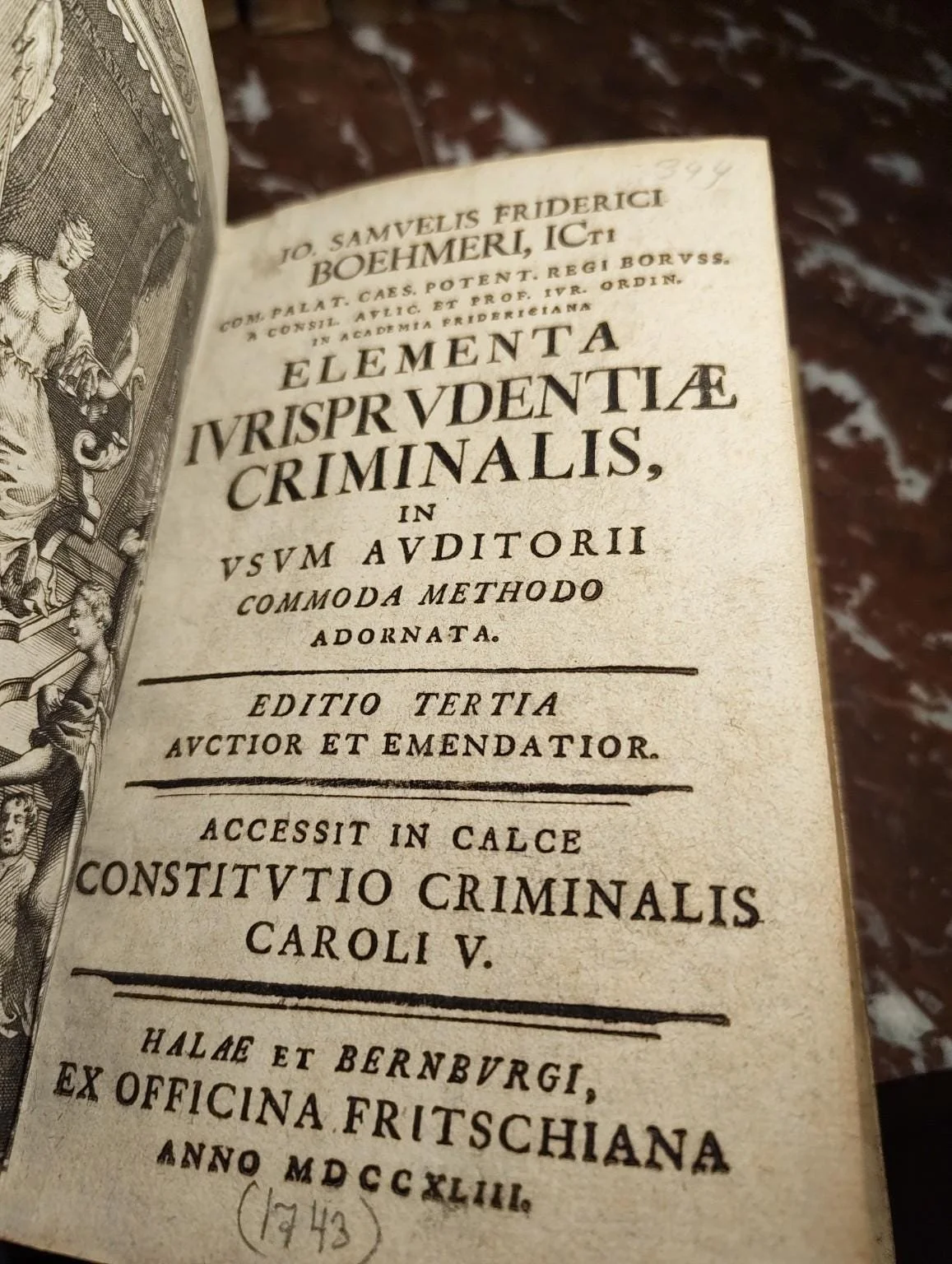
A central legal text of the German Enlightenment, uniting early modern criminal theory with the foundational penal code of the Holy Roman Empire
This 1743 third edition of Elementa Iurisprudentiae Criminalis by Johann Samuel Friedrich Boehmer represents one of the most influential criminal law textbooks of the German Enlightenment. Printed in Halle, the volume combines Boehmer’s systematic treatment of criminal jurisprudence with the full text of the Constitutio Criminalis Carolina, the landmark penal code issued under Emperor Charles V in 1532.
Boehmer’s work served as a bridge between early modern legal tradition and the emerging rationalism of eighteenth century scholarship. His interpretation of the Carolina code, presented in both Latin and German, reflects a period in which academic jurists sought to clarify procedure, codify principles of evidence, and reconcile inherited legal structures with Enlightenment concepts of proportionality and justice. As a teaching text, the book shaped generations of jurists across the German lands and remained a known authority in discussions of criminal reform.
The volume opens with an engraved frontispiece and is preserved in its original eighteenth century binding, which remains in good condition with visible signs of responsible use. The pages are clean and complete, printed in a crisp Latin and German typeface that exemplifies mid eighteenth century Halle production. The only noted flaw is a torn lower edge on page 165, a minor blemish that does not affect the text.
As an artefact, the book stands at the intersection of legal history, Enlightenment pedagogy, and the transmission of early modern criminal theory. It presents the Carolina code not as an isolated document but as part of a living academic tradition that sought to understand and refine the administration of justice within the Holy Roman Empire.
This is an appealing and well preserved copy for collectors of legal history, scholars of early modern jurisprudence, and libraries that seek representative examples of eighteenth century continental law.
Introduction
Published in Stockholm by Rabén & Sjögren in 1962, Bilbo: En hobbits äventyr is the first edition of Britt G. Hallqvist’s Swedish translation of J. R. R. Tolkien’s The Hobbit and the original appearance of Tove Jansson’s illustrations for the story.
The edition represents an exceptional meeting of two highly distinctive imaginative worlds. Jansson, internationally known as the creator of the Moomins, approached Tolkien’s Middle-earth with complete visual independence. Her strange creatures, immense landscapes and vulnerable travelling figures create an interpretation that is atmospheric, unsettling and unmistakably her own.
Physical description
Author: J. R. R. Tolkien
Title: Bilbo: En hobbits äventyr
Swedish translation by Britt G. Hallqvist
Illustrated by Tove Jansson
Stockholm: Rabén & Sjögren, 1962
Printed in Örebro by AB Littorin Rydén Boktryckeri
First edition of Hallqvist’s translation and Jansson’s illustrations
Swedish text
Octavo, 8vo
308 pages
Illustrated throughout in black and white, with numerous full-page compositions
Publisher’s original pictorial boards with green cloth spine and gilt lettering
Complete and structurally sound
Rubbing, scratches and other surface wear to the boards
Wear to the edges, corners and ends of the spine
Text block age-toned, with some spotting, marks and occasional marginal staining
Illustrations remain well preserved and clearly printed
Context
The edition was created during Astrid Lindgren’s influential period as an editor at Rabén & Sjögren. Lindgren was instrumental in inviting Tove Jansson to illustrate Tolkien’s story, bringing together three major figures in twentieth-century children’s literature: Tolkien as author, Jansson as illustrator and Lindgren as editor.
Jansson did not attempt to imitate Tolkien’s own drawings or anticipate the visual conventions later established around Middle-earth. Instead, she developed an independent Nordic interpretation in which landscapes frequently overwhelm the characters and familiar figures are rendered in surprising forms.
The most famous example is her full-page illustration of Bilbo’s encounter with Gollum. Rather than portraying Gollum as the small, emaciated creature familiar from later illustrations and film adaptations, Jansson presents him as an enormous, almost primordial being towering over Bilbo. The image reflects the relative ambiguity of Gollum’s physical appearance in the text available to Jansson and has become one of the most discussed illustrations associated with this edition.
Significance
This edition is valued not simply as an early Swedish publication of Tolkien’s work, but as a distinctive artistic interpretation of The Hobbit. Jansson’s illustrations form a self-contained vision of Middle-earth, shaped by the same sensitivity to darkness, solitude, landscape and strange creatures that characterises much of her wider work.
Its importance also lies in the unusual collaboration behind it. The involvement of Astrid Lindgren connects the volume directly with the history of Rabén & Sjögren and the development of modern Scandinavian children’s literature, while Jansson’s illustrations unite the worlds of Tolkien and the Moomins within a single publication.
The celebrated Gollum image, the original pictorial binding and the first appearance of Jansson’s complete series of illustrations make the 1962 Bilbo an important and immediately recognisable edition for collectors of Tolkien, Tove Jansson and twentieth-century book illustration.