Introduction
An exceptionally decorative parchment leaf from a late medieval French devotional manuscript, most probably a Book of Hours, containing part of the Litania Sanctorum, or Litany of the Saints. Written on both sides in a formal Gothic hand, the leaf presents a rhythmic sequence of invocations, each asking a saint to intercede for the reader: ora pro nobis, “pray for us.”
The visual richness of the leaf is particularly striking. Rows of gold, blue and red initials form a continuous ornamental border beside the text, while gilt and coloured line fillers extend across the page. The repetition of prayer and decoration transforms the litany into a carefully ordered act of devotion, at once textual, visual and meditative.
Most significantly, the litany includes Saint Martial among the apostles, together with Saint Leonard and Saint Gerald. This combination points strongly toward a manuscript associated with Limoges or the surrounding Limousin region, where Saint Martial was venerated not merely as the city’s first bishop, but according to a distinctive medieval tradition, as an apostolic figure.
Physical description
• Single parchment leaf, written on both recto and verso
• Leaf dimensions: 19 × 14 cm
• Framed dimensions: 24 × 18 cm
• Latin text in a formal Gothic bookhand, written in dark brown to black ink
• Text from the Litania Sanctorum, with repeated invocations ending ora pro nobis
• Numerous initials illuminated in gold, blue and red, arranged as a decorative vertical sequence along the left side of the text block
• Extensive line fillers in gold, blue and red
• Fine marginal penwork in black and red ink
• Saints named include Martial, Leonard, Gerald, Martin, Nicholas, Augustine, Lawrence, Vincent, George, Christopher and others
• Later pencil foliation or collector’s number “96” in the upper right corner
• France, probably Limoges or the Limousin region, 15th century, perhaps second half of the century
• Visible toning, staining, surface wear and waviness to the parchment, consistent with age and earlier exposure to moisture
• Mounted in a window mat and adhesively attached at the upper edge only
• Professional conservation assessment is recommended before any attempt at removal or remounting
Context
The Litany of the Saints was a central devotional text in medieval Christianity. In a Book of Hours it commonly followed the Penitential Psalms, guiding the reader through a solemn sequence of appeals to apostles, martyrs, confessors, virgins and the collective company of heaven. Each short invocation invited the reader to participate in a spiritual community extending far beyond the visible world.
On this leaf, the ordered procession of saints moves from apostles and evangelists into martyrs and confessors. Names such as Stephen, Lawrence, Vincent, Sebastian, Martin, Augustine and Nicholas belong to the wider devotional vocabulary of the medieval Church. Others are more revealing. Saint Martial, Saint Leonard and Saint Gerald evoke the religious landscape of south-central France, especially Limousin and its neighbouring regions.
Saint Martial is particularly important. In medieval Limoges, his cult developed around the belief that he had been sent directly as an apostle to bring Christianity to Gaul. His placement here among the apostles rather than among ordinary bishops or confessors is therefore a meaningful regional marker. The leaf does not merely preserve a generic litany. It retains evidence of the local devotional identity of the manuscript from which it was removed.
Significance
This leaf is compelling both as an illuminated object and as a fragment of a once coherent devotional manuscript. Its extensive use of gold and colour gives unusual visual prominence to a text based on repetition and prayer, allowing each invocation to appear as a separate, carefully ornamented act of appeal.
Its greater significance lies in the particular saints it records. The inclusion and liturgical placement of Saint Martial, together with Leonard and Gerald, provide an unusually informative clue to the original manuscript’s regional character. The leaf can therefore be approached not simply as an attractive medieval fragment, but as surviving evidence of a devotional tradition associated with Limoges or the wider Limousin region.
Despite later staining, waviness and an unsuitable adhesive mounting at the upper edge, the leaf retains remarkable presence. Its luminous gold initials, disciplined Gothic script and locally meaningful litany offer a tangible connection to the private prayers, sacred geography and manuscript craftsmanship of fifteenth-century France.
Introduction
An exceptionally decorative parchment leaf from a late medieval French devotional manuscript, most probably a Book of Hours, containing part of the Litania Sanctorum, or Litany of the Saints. Written on both sides in a formal Gothic hand, the leaf presents a rhythmic sequence of invocations, each asking a saint to intercede for the reader: ora pro nobis, “pray for us.”
The visual richness of the leaf is particularly striking. Rows of gold, blue and red initials form a continuous ornamental border beside the text, while gilt and coloured line fillers extend across the page. The repetition of prayer and decoration transforms the litany into a carefully ordered act of devotion, at once textual, visual and meditative.
Most significantly, the litany includes Saint Martial among the apostles, together with Saint Leonard and Saint Gerald. This combination points strongly toward a manuscript associated with Limoges or the surrounding Limousin region, where Saint Martial was venerated not merely as the city’s first bishop, but according to a distinctive medieval tradition, as an apostolic figure.
Physical description
• Single parchment leaf, written on both recto and verso
• Leaf dimensions: 19 × 14 cm
• Framed dimensions: 24 × 18 cm
• Latin text in a formal Gothic bookhand, written in dark brown to black ink
• Text from the Litania Sanctorum, with repeated invocations ending ora pro nobis
• Numerous initials illuminated in gold, blue and red, arranged as a decorative vertical sequence along the left side of the text block
• Extensive line fillers in gold, blue and red
• Fine marginal penwork in black and red ink
• Saints named include Martial, Leonard, Gerald, Martin, Nicholas, Augustine, Lawrence, Vincent, George, Christopher and others
• Later pencil foliation or collector’s number “96” in the upper right corner
• France, probably Limoges or the Limousin region, 15th century, perhaps second half of the century
• Visible toning, staining, surface wear and waviness to the parchment, consistent with age and earlier exposure to moisture
• Mounted in a window mat and adhesively attached at the upper edge only
• Professional conservation assessment is recommended before any attempt at removal or remounting
Context
The Litany of the Saints was a central devotional text in medieval Christianity. In a Book of Hours it commonly followed the Penitential Psalms, guiding the reader through a solemn sequence of appeals to apostles, martyrs, confessors, virgins and the collective company of heaven. Each short invocation invited the reader to participate in a spiritual community extending far beyond the visible world.
On this leaf, the ordered procession of saints moves from apostles and evangelists into martyrs and confessors. Names such as Stephen, Lawrence, Vincent, Sebastian, Martin, Augustine and Nicholas belong to the wider devotional vocabulary of the medieval Church. Others are more revealing. Saint Martial, Saint Leonard and Saint Gerald evoke the religious landscape of south-central France, especially Limousin and its neighbouring regions.
Saint Martial is particularly important. In medieval Limoges, his cult developed around the belief that he had been sent directly as an apostle to bring Christianity to Gaul. His placement here among the apostles rather than among ordinary bishops or confessors is therefore a meaningful regional marker. The leaf does not merely preserve a generic litany. It retains evidence of the local devotional identity of the manuscript from which it was removed.
Significance
This leaf is compelling both as an illuminated object and as a fragment of a once coherent devotional manuscript. Its extensive use of gold and colour gives unusual visual prominence to a text based on repetition and prayer, allowing each invocation to appear as a separate, carefully ornamented act of appeal.
Its greater significance lies in the particular saints it records. The inclusion and liturgical placement of Saint Martial, together with Leonard and Gerald, provide an unusually informative clue to the original manuscript’s regional character. The leaf can therefore be approached not simply as an attractive medieval fragment, but as surviving evidence of a devotional tradition associated with Limoges or the wider Limousin region.
Despite later staining, waviness and an unsuitable adhesive mounting at the upper edge, the leaf retains remarkable presence. Its luminous gold initials, disciplined Gothic script and locally meaningful litany offer a tangible connection to the private prayers, sacred geography and manuscript craftsmanship of fifteenth-century France.


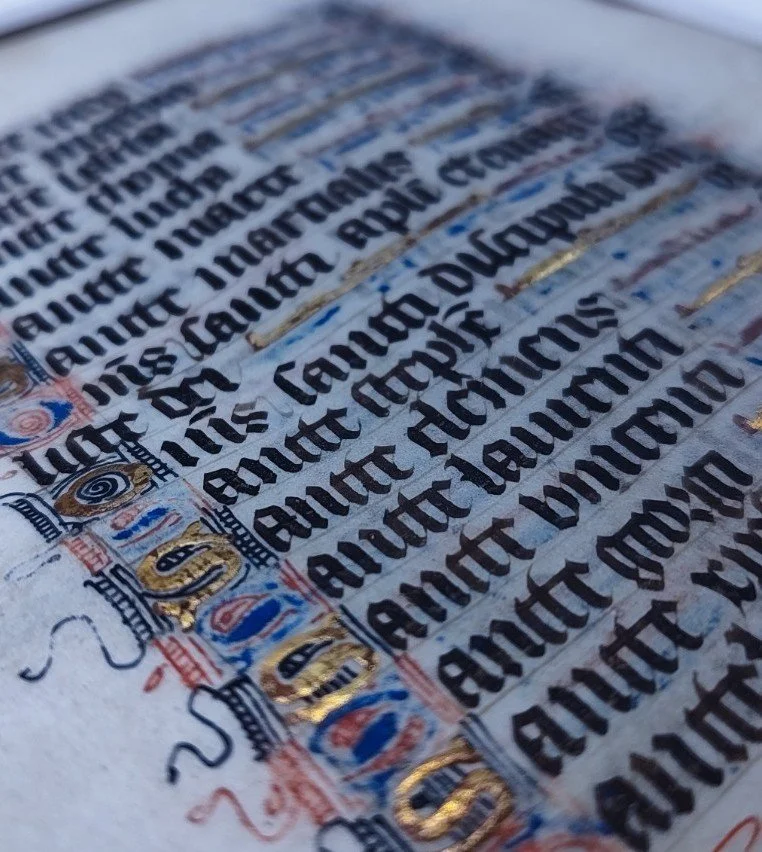 Image 1 of 7
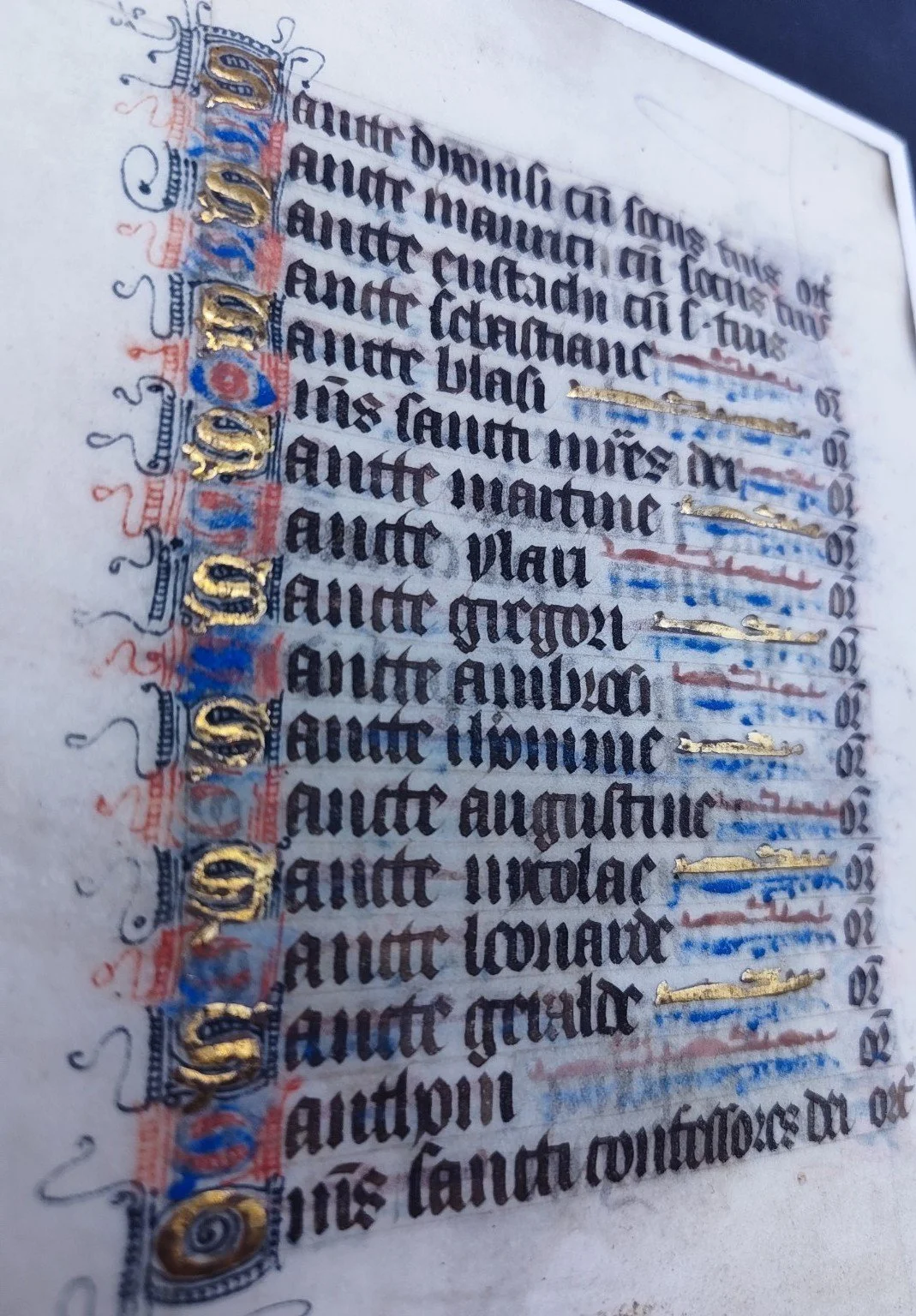 Image 2 of 7
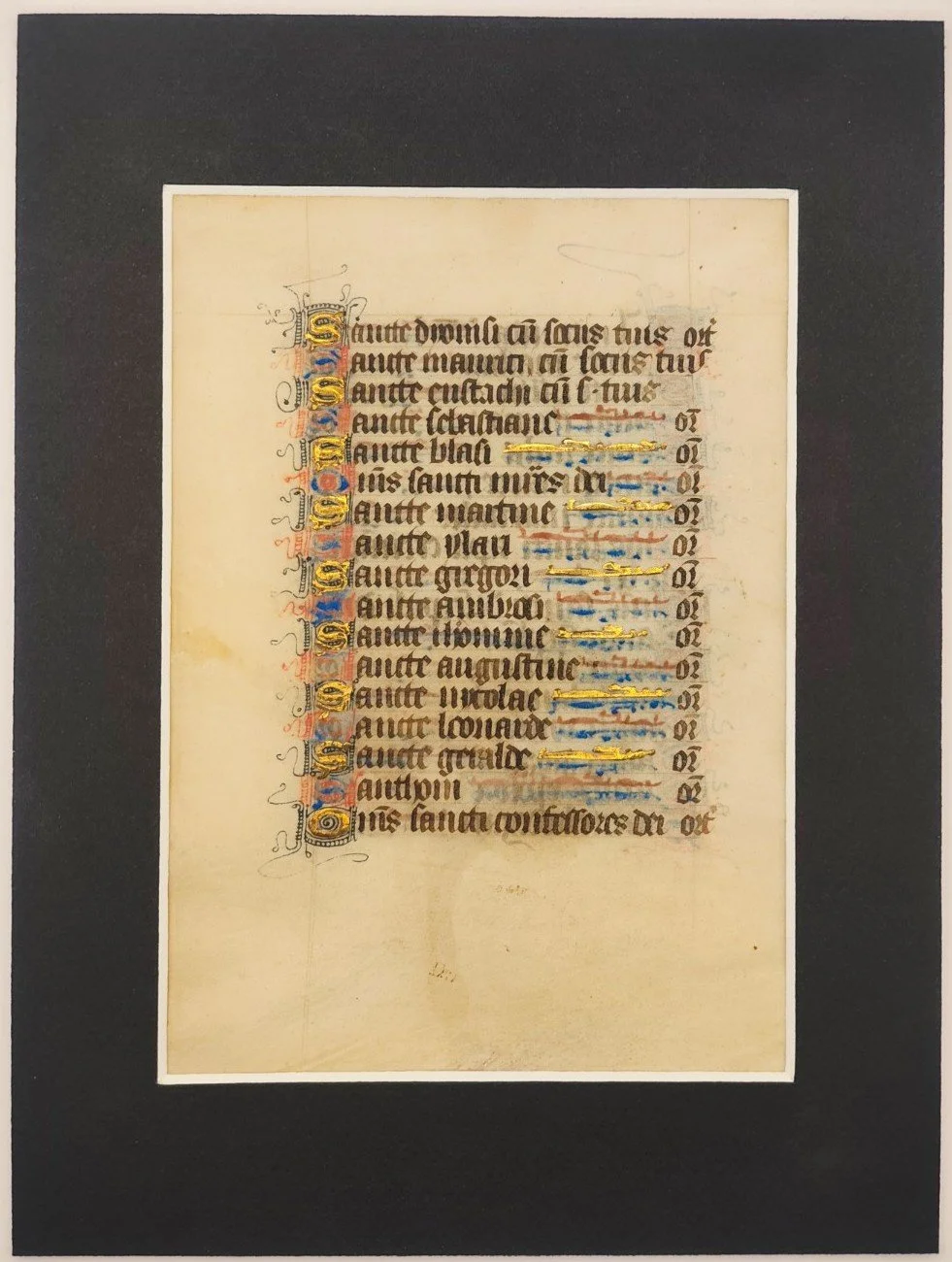 Image 3 of 7
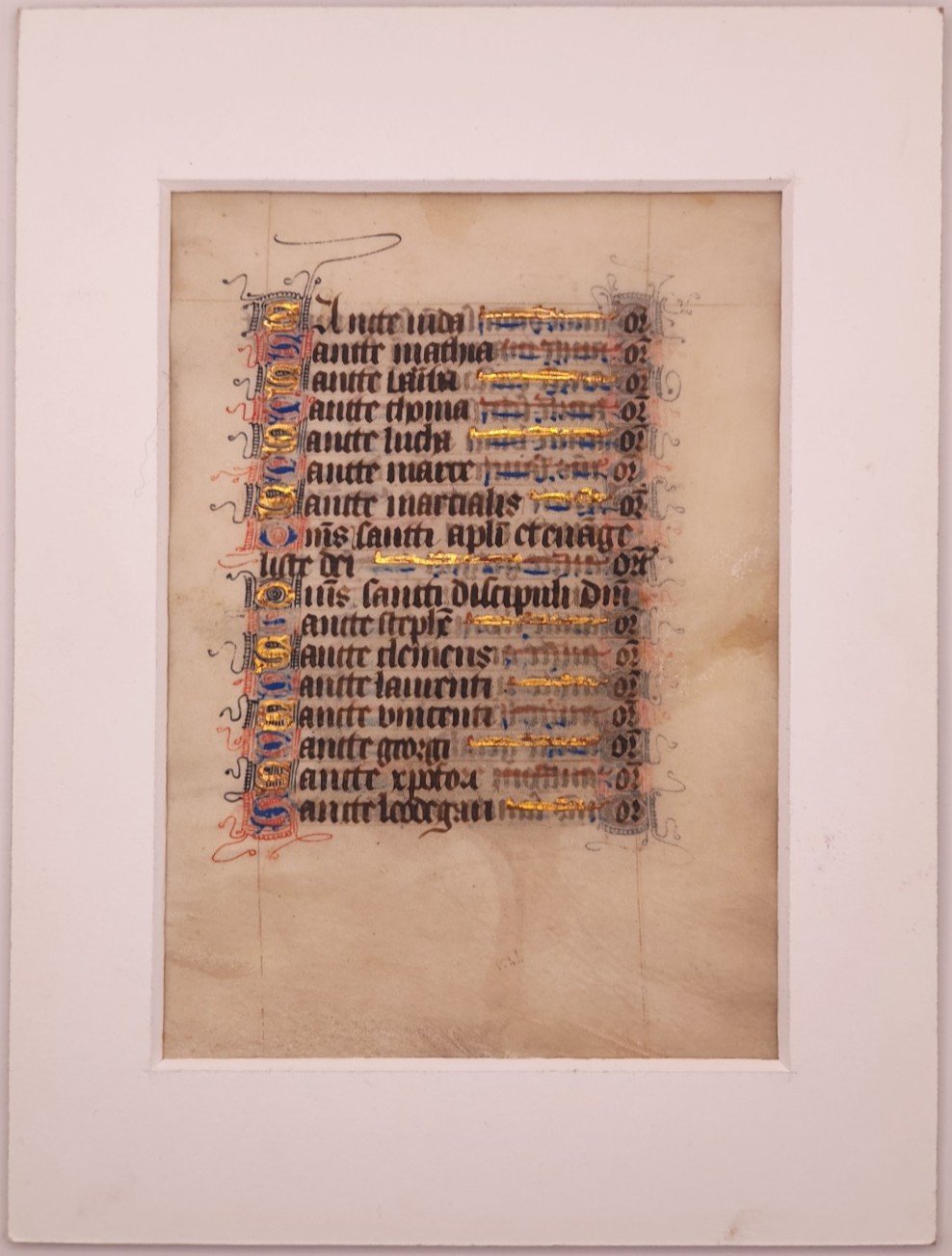 Image 4 of 7
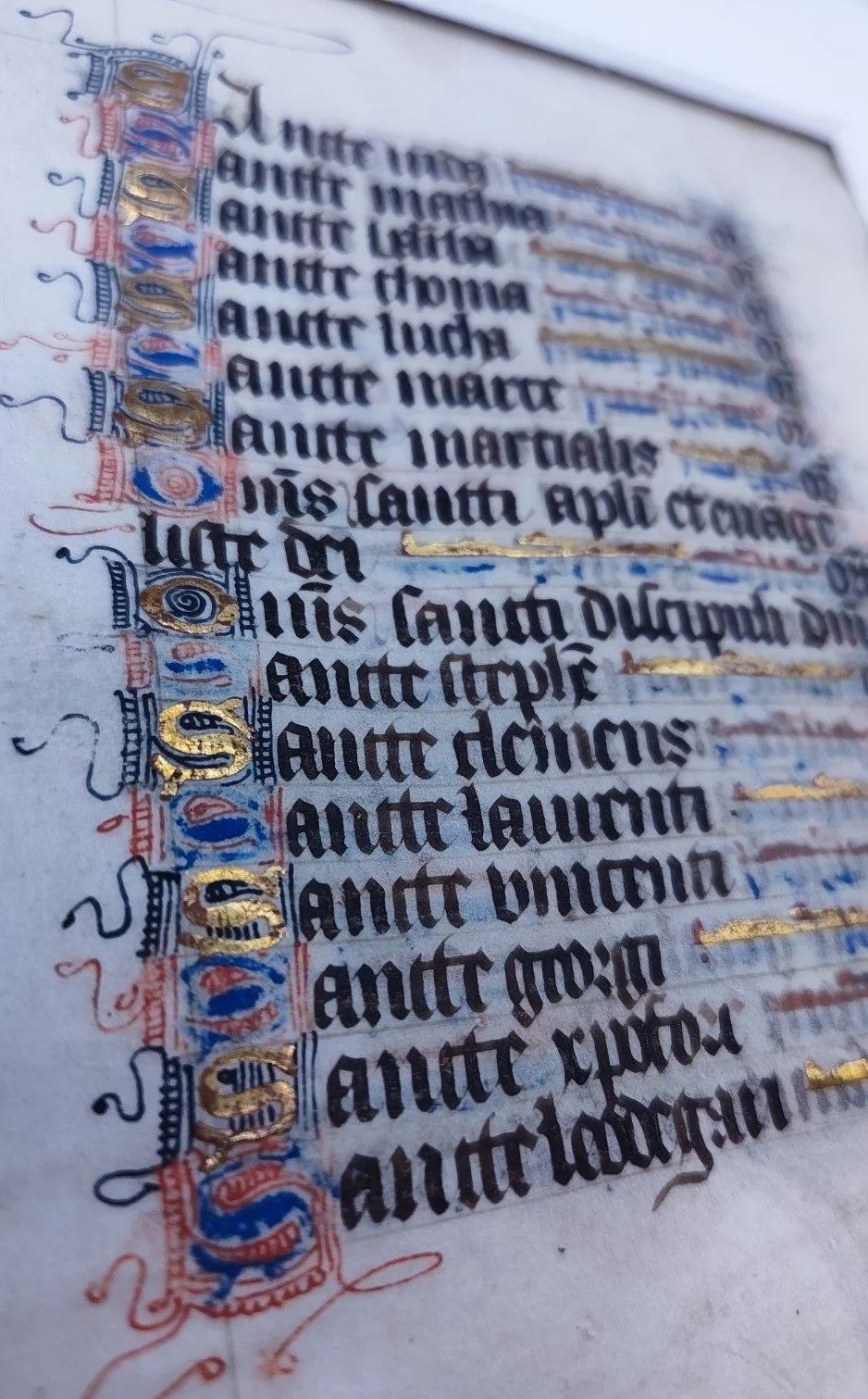 Image 5 of 7
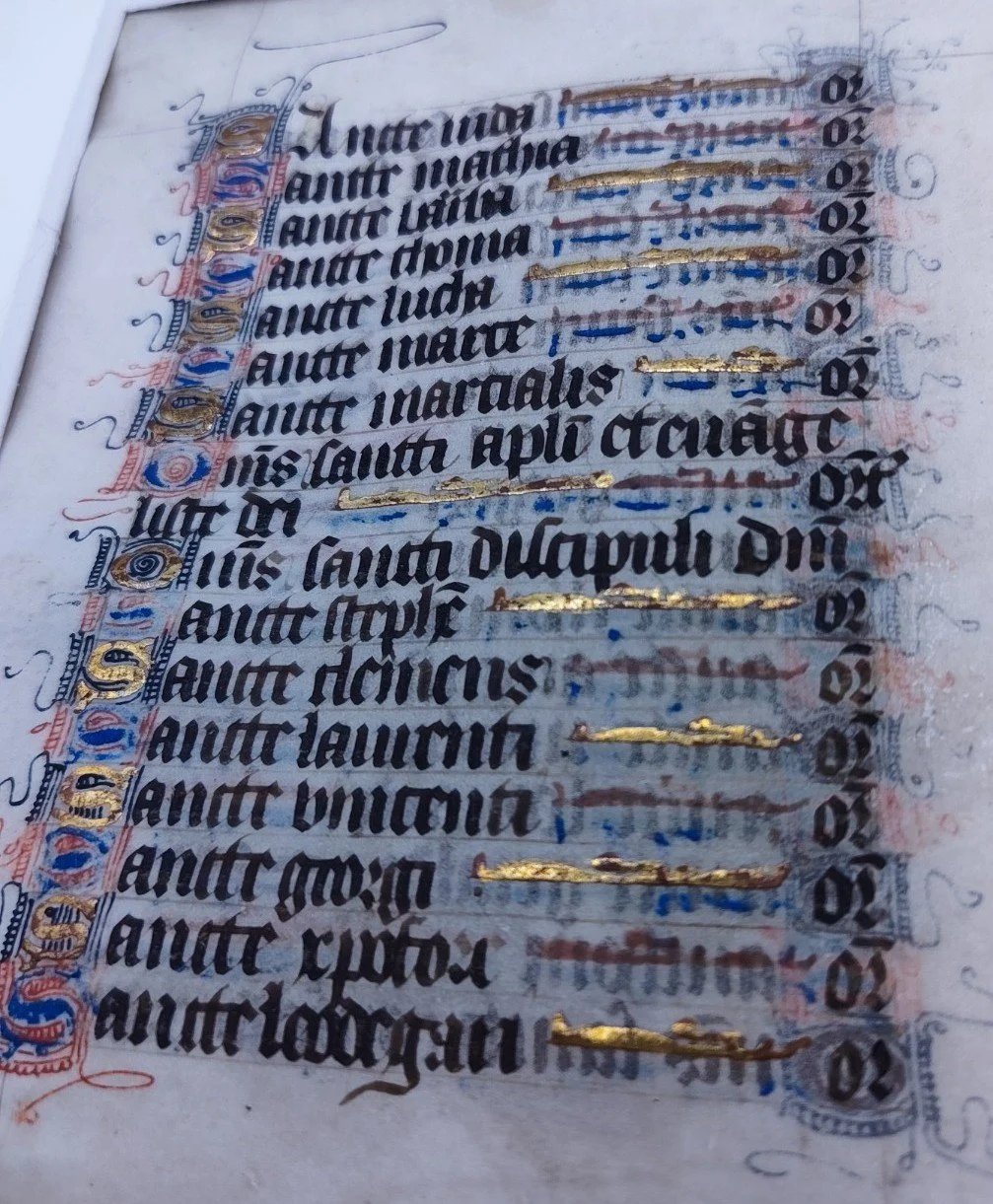 Image 6 of 7
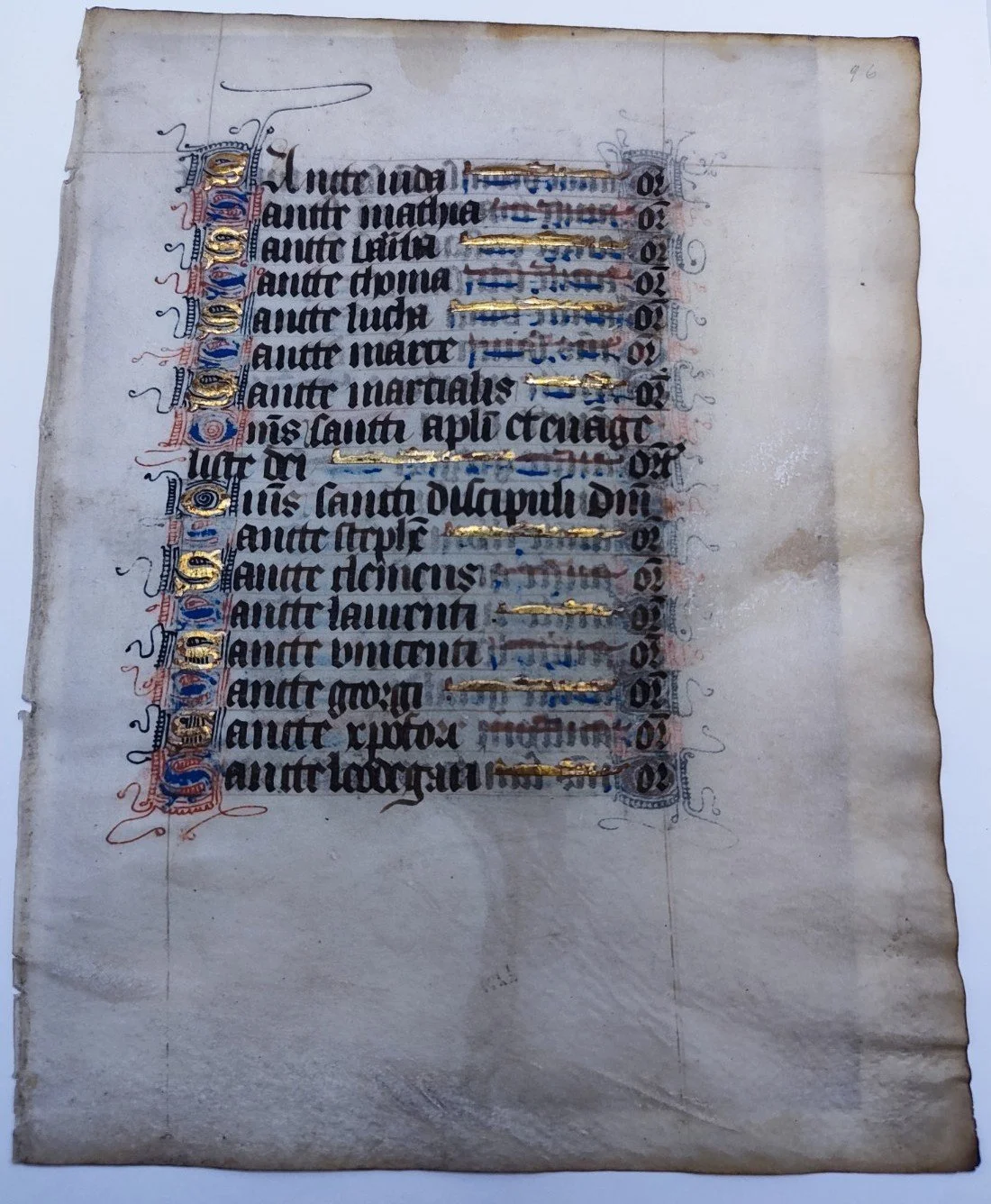 Image 7 of 7