Introduction
This official report, delivered by Maximilien Robespierre to the National Convention in the second year of the French Republic, stands as one of the most revealing documents of the revolutionary attempt to reshape civic life. In it, Robespierre outlines the purpose and structure of the new décadi festivals that were meant to replace the traditional Christian calendar with a sequence of republican ceremonies. The text reflects the ambition to create a moral and civic framework rooted in revolutionary virtue rather than inherited religious forms. It is a rare instance in which the ideological program of the Committee of Public Safety takes on a concrete, ceremonial form, intended for the daily life of citizens.
The present copy is a contemporary printing from 1794, preserved in a later plain paper binding that protects the original text block. There is light staining, including a circular mark on the preliminaries, together with scattered foxing, yet the work remains complete and legible. As a primary document from the most intense phase of the Revolution, it offers a direct view into the construction of republican culture at a moment when political ideals and public ritual were inseparable.
Bibliographical details
Title: Le Comité de salut public à la convention nationale. Rapport fait en son nom par Robespierre
Place: Paris
Date: 1794
Format: Octavo
Pagination: 58 pages
Binding: Later plain paper boards, modern rebinding
Language: French
Condition: Light staining and foxing, one circular stain on preliminaries, text block complete and well preserved
Provenance: Ex Libris Per-Olof Engsner
Significance
As a testimony to the revolutionary effort to redefine the social fabric through public ritual, this report occupies a distinctive place in the history of political culture. It illustrates how the Committee of Public Safety understood the relationship between morality, collective identity and state authority. The pamphlet’s survival underscores the gravity with which such texts were produced and circulated during a year when the Revolution sought to establish a new civic order. For historians of eighteenth century France, for collectors of revolutionary printing and for those interested in the creation of republican symbolism, this document represents an essential primary source.
Introduction
This official report, delivered by Maximilien Robespierre to the National Convention in the second year of the French Republic, stands as one of the most revealing documents of the revolutionary attempt to reshape civic life. In it, Robespierre outlines the purpose and structure of the new décadi festivals that were meant to replace the traditional Christian calendar with a sequence of republican ceremonies. The text reflects the ambition to create a moral and civic framework rooted in revolutionary virtue rather than inherited religious forms. It is a rare instance in which the ideological program of the Committee of Public Safety takes on a concrete, ceremonial form, intended for the daily life of citizens.
The present copy is a contemporary printing from 1794, preserved in a later plain paper binding that protects the original text block. There is light staining, including a circular mark on the preliminaries, together with scattered foxing, yet the work remains complete and legible. As a primary document from the most intense phase of the Revolution, it offers a direct view into the construction of republican culture at a moment when political ideals and public ritual were inseparable.
Bibliographical details
Title: Le Comité de salut public à la convention nationale. Rapport fait en son nom par Robespierre
Place: Paris
Date: 1794
Format: Octavo
Pagination: 58 pages
Binding: Later plain paper boards, modern rebinding
Language: French
Condition: Light staining and foxing, one circular stain on preliminaries, text block complete and well preserved
Provenance: Ex Libris Per-Olof Engsner
Significance
As a testimony to the revolutionary effort to redefine the social fabric through public ritual, this report occupies a distinctive place in the history of political culture. It illustrates how the Committee of Public Safety understood the relationship between morality, collective identity and state authority. The pamphlet’s survival underscores the gravity with which such texts were produced and circulated during a year when the Revolution sought to establish a new civic order. For historians of eighteenth century France, for collectors of revolutionary printing and for those interested in the creation of republican symbolism, this document represents an essential primary source.


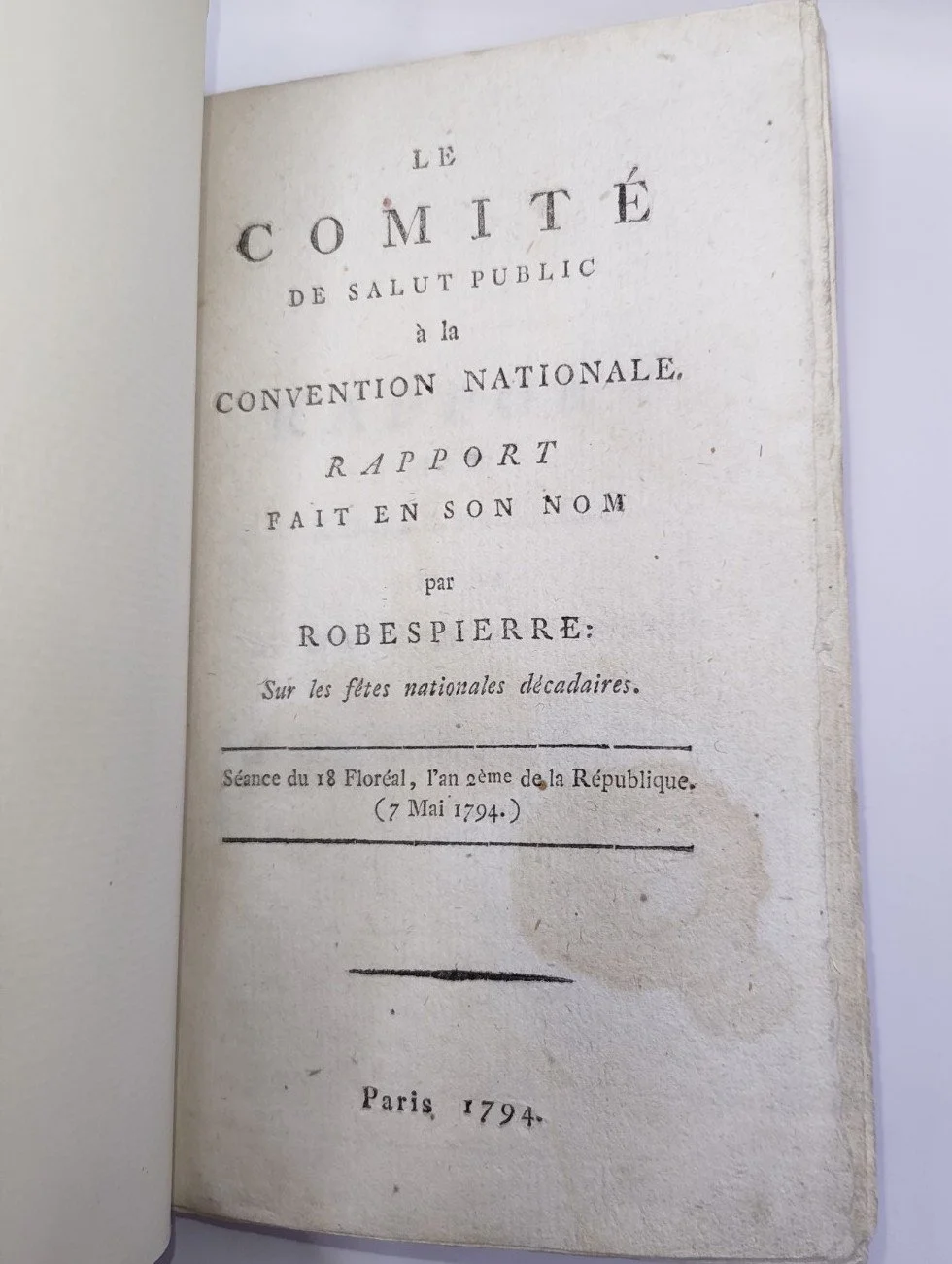 Image 1 of 8
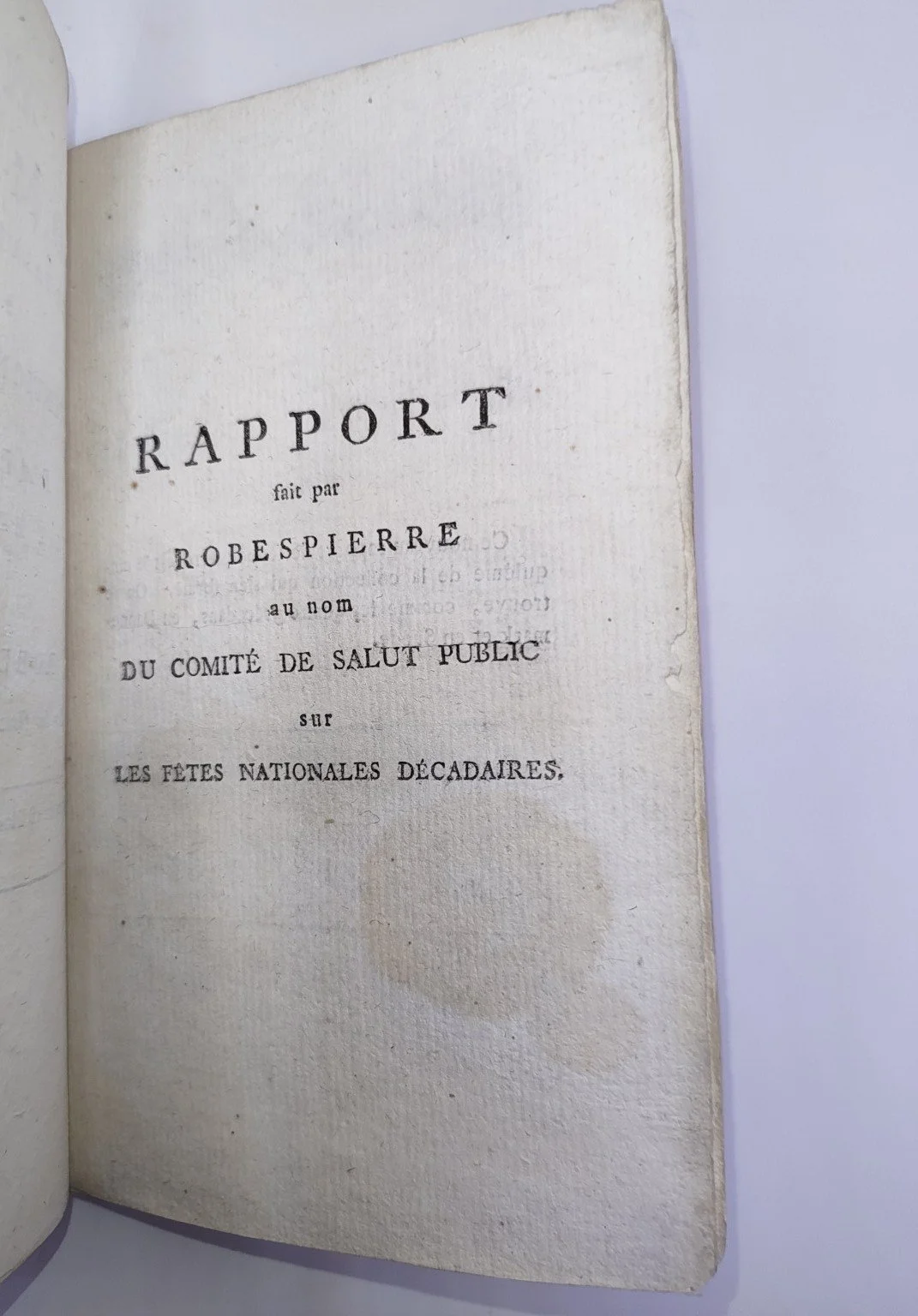 Image 2 of 8
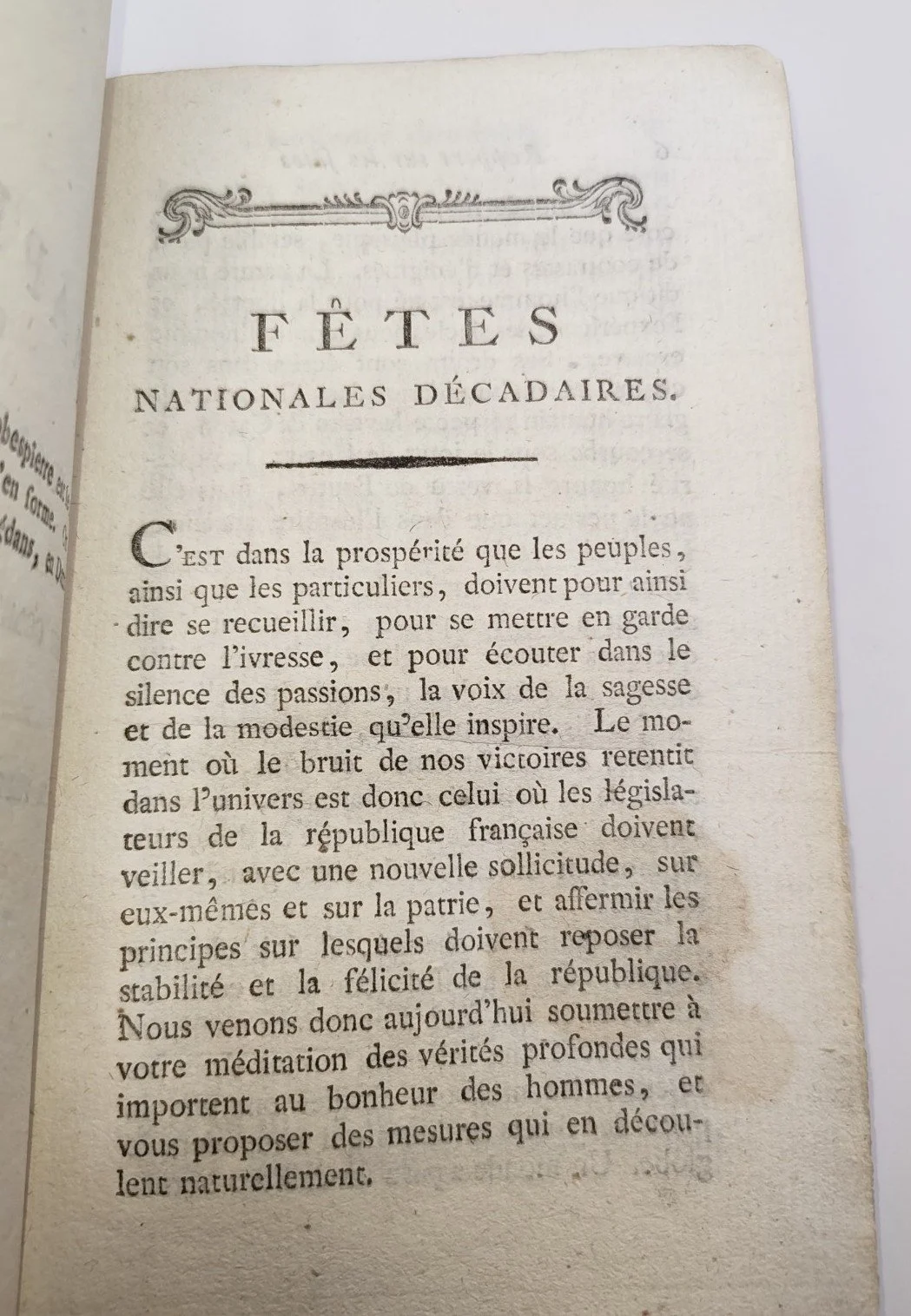 Image 3 of 8
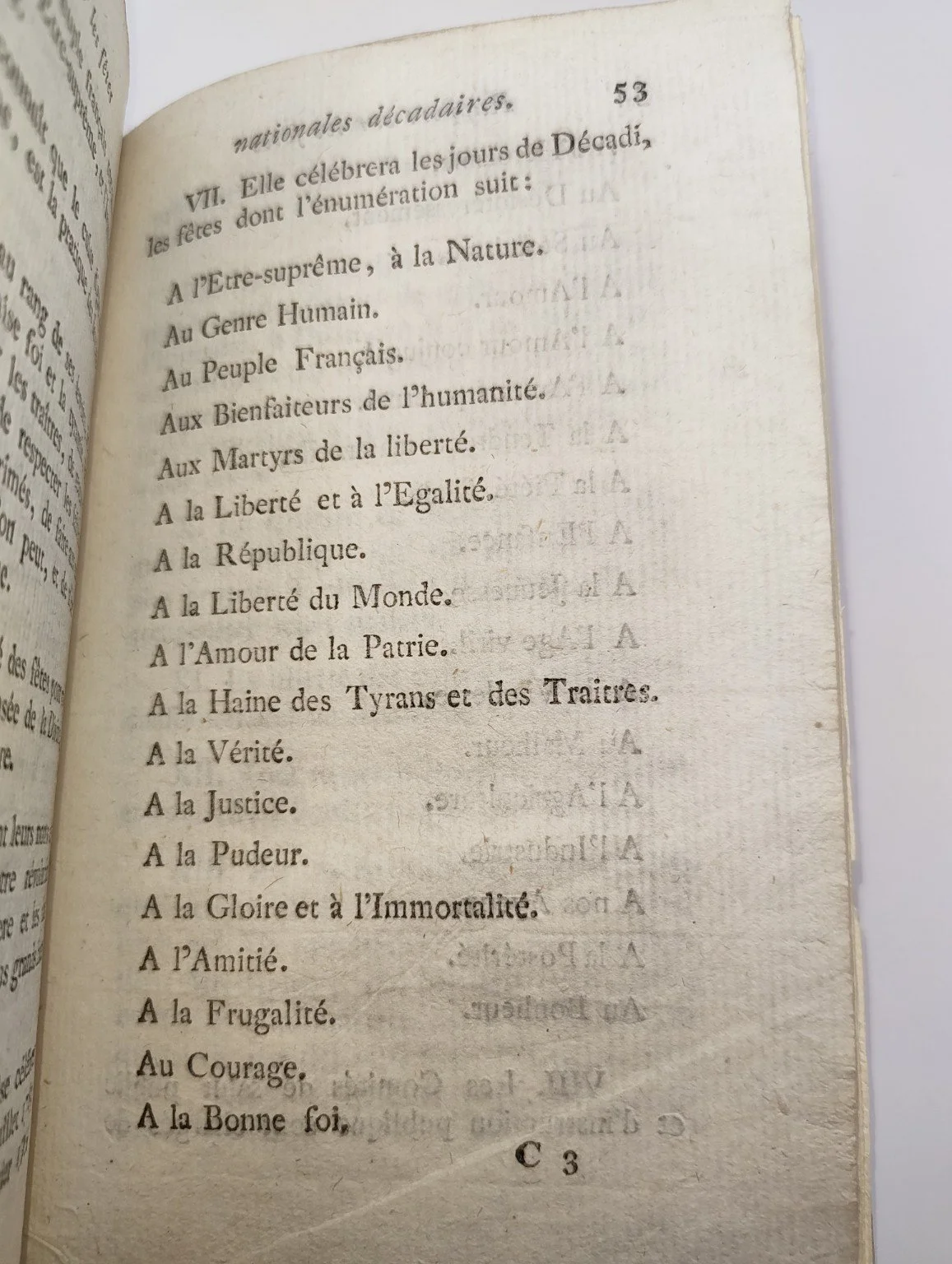 Image 4 of 8
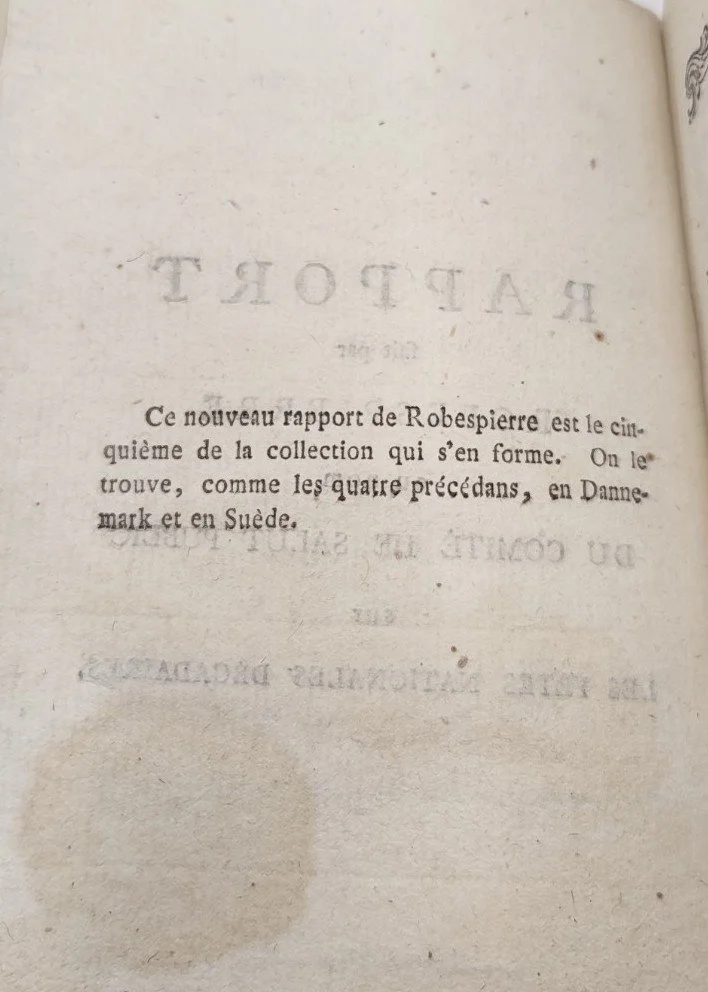 Image 5 of 8
 Image 6 of 8
 Image 7 of 8
 Image 8 of 8